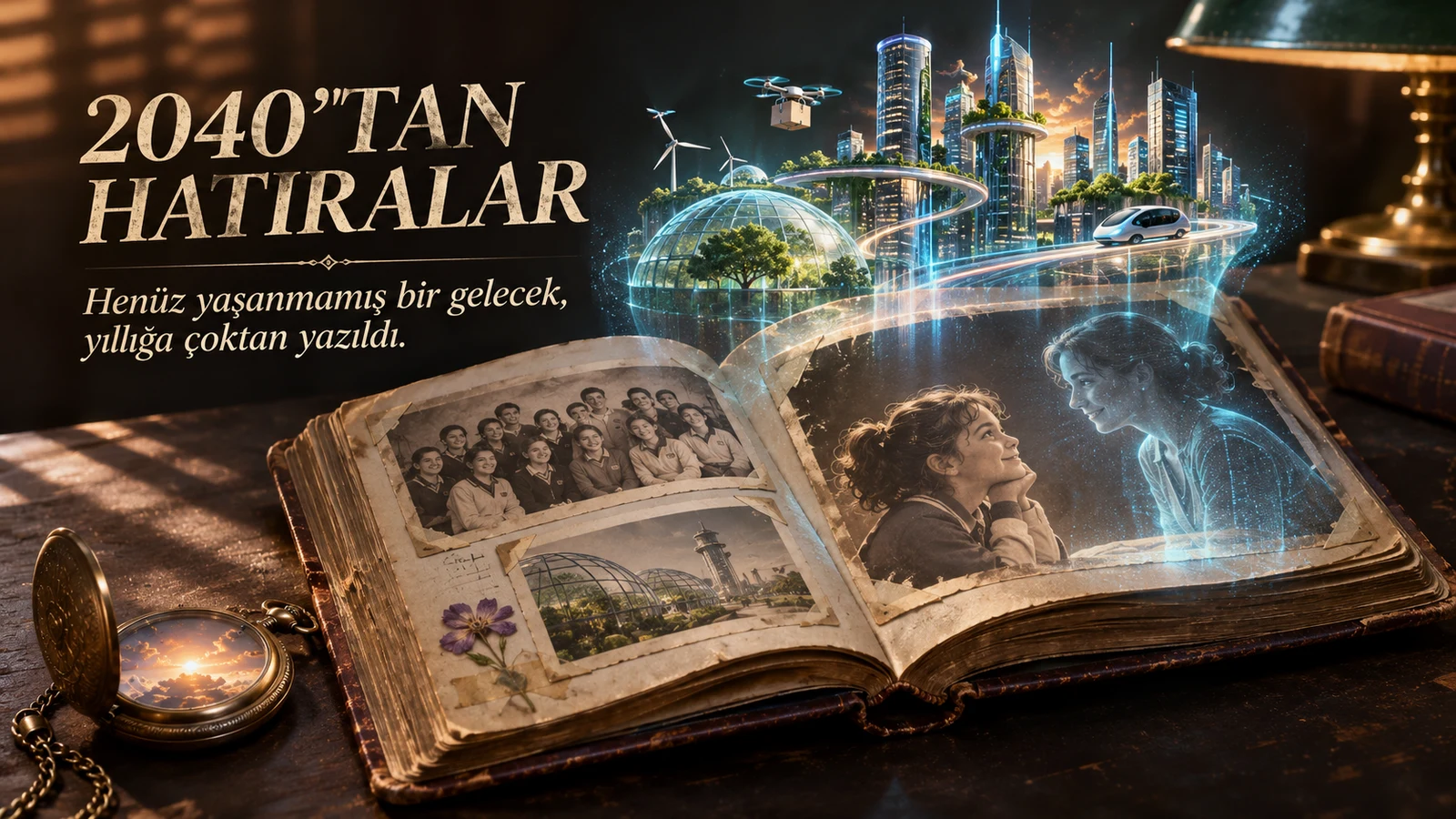
Most exhibitions show the future with bright screens, flying vehicles, and flawless smart cities. The Yearbook of 2040 chooses a more personal object: the school yearbook. It presents technological and social events that haven't happened yet as shared memories from years ago.
Developed by 25framesdesign, inspired by Dr. Jiahong Chen's research, the interactive installation is on display at the Festival of the Mind from 6–15 November 2026. In the constructed world of 2040, almost everything is connected and "smartified." Visitors explore the turning points of this transformation not as a future report but as a memory album.
Why a yearbook?
School yearbooks combine grand historical narratives with everyday details. Alongside official events, there are nicknames, small achievements, friendships, and notes written to the future. This format takes technological prediction out of abstract trends and brings it closer to what people will accept as normal and what they will miss.
Pretending to look at 2040 from the past changes the language of prediction. Instead of saying "smart homes will become widespread," it forces us to think about what memories a generation that grew up in these homes will collect. In an era where everything generates data, whose graduation photo will it be? How much information will the home, school, and city hold about us?
Why is the future told in the past tense?
Endless future-tense sentences can feel distant. Telling the future as an event that has already happened, however, shows the consequences of decisions more concretely. This is where the power of speculative design lies: instead of offering definitive prophecies, it makes a particular possibility experienceable.
The installation doesn't say "2040 will definitely be like this." It invites visitors to weigh whether they actually want this future. Along with the convenience of connected objects, issues like surveillance, dependency, and the right to be forgotten seep into the yearbook's pages. The relationship between design and surveillance in Cinfikirli here becomes the infrastructure of everyday memories.
Is smartifying always improving?
Adding sensors and network connectivity to an object doesn't automatically make it more useful. Connectivity brings new problems such as maintenance, security, data ownership, and product lifespan. The yearbook of 2040 allows us to test the optimism carried by the word "smart" by placing it within personal life.
A future where a school bag tracks the student, the classroom measures attention, or the home behaves according to emotional state can be both comforting and disturbing. The difference depends less on the existence of technology and more on who decides, where the data goes, and whether it's possible to opt out.
Cinfikirli's reading
The Yearbook of 2040 is less about predicting the future and more about rehearsing how to remember it. This reverse time movement takes the technology debate out of product features and connects it to cultural memory. What we accept as innovation today will become which generation's childhood normal in the future?
The yearbook's pages look to the future while simultaneously recording today's decisions. Perhaps the most useful question of speculative design isn't "what will happen?" but "if this had happened, which decision would we regret?"