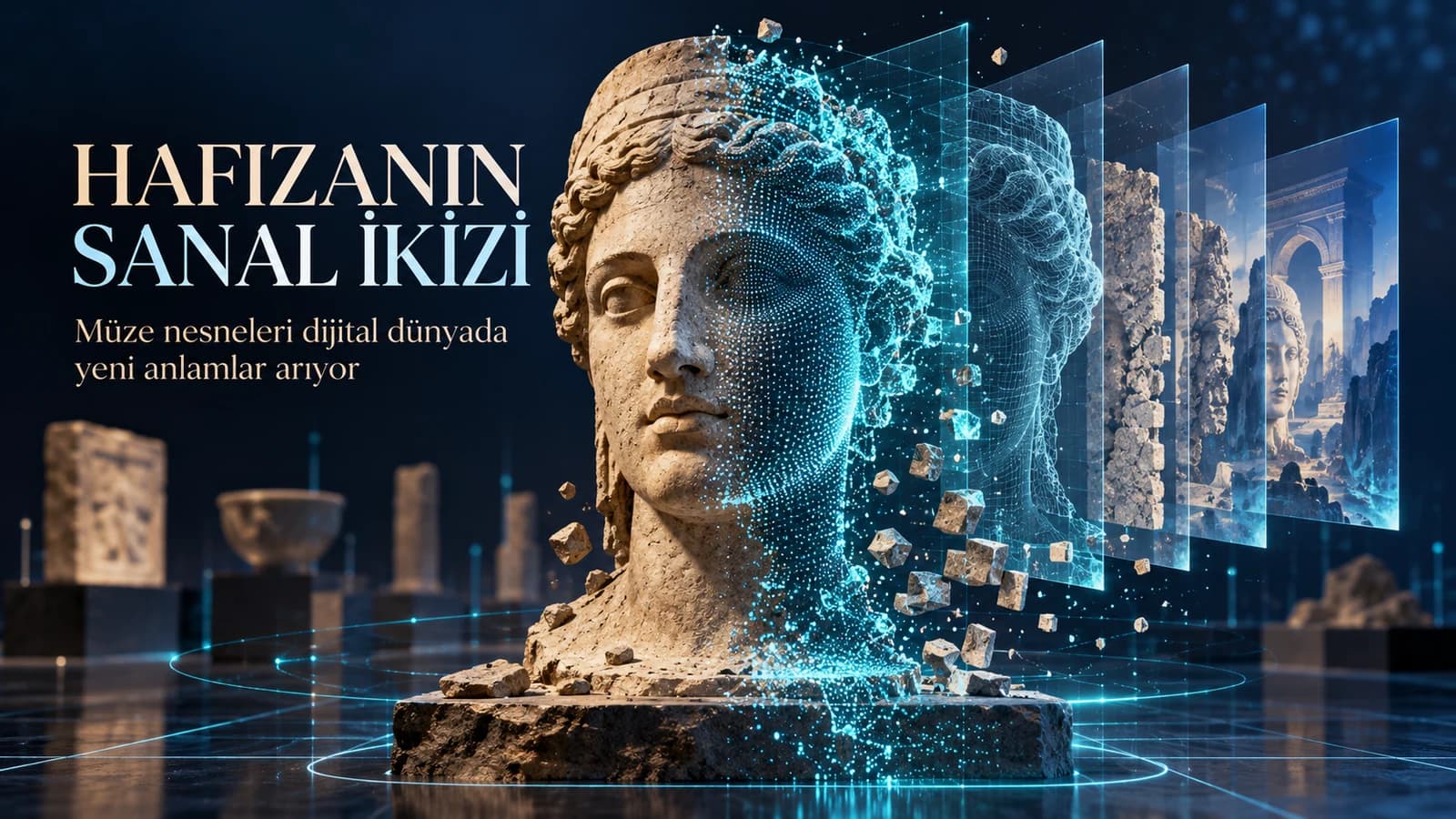
Is scanning a sculpture and turning it into a three-dimensional model enough to bring it into the digital world? PolyKosmik: Materiality and Memory in the Digital World, opened at MUŻA in Valletta, Malta, instead of giving a technical “yes” to this question, looks at how the meaning of the object changes. The exhibition, rather than producing a digital copy of cultural heritage, discusses who will speak within that copy.
The exhibition, held between 30 October and 8 November 2026, brings the experiments of the EU-supported IMPULSE research project to the public. In virtual worlds developed with the contributions of Heritage Malta, Magna Żmien, and the University of Malta, 3D-scanned objects, archival images, sound recordings, and historical documents are brought together again through space, sound, and interaction.
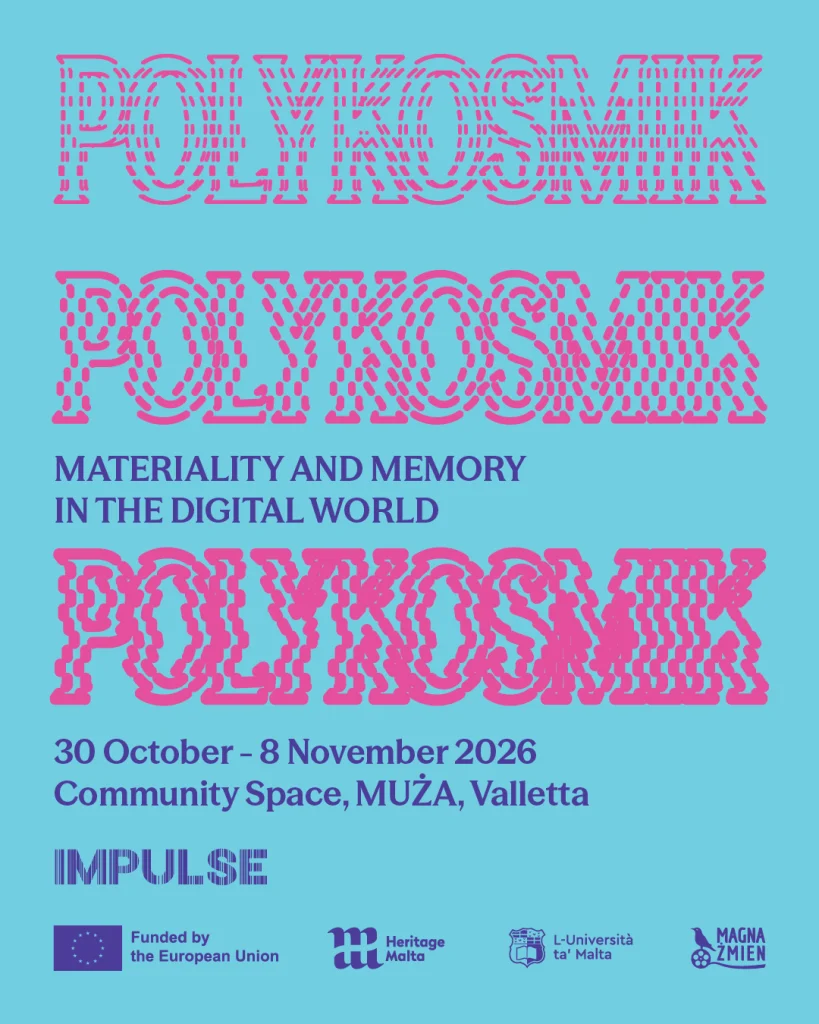
PolyKosmik exhibition promotional image. Image: Heritage Malta / IMPULSE. Source
Digitisation is more than copying
The digitalisation story of museums has long been told through access: scanning the object, adding it to the catalogue, and making it remotely visible. PolyKosmik does not underestimate this achievement, but moves to the next question. When an object removed from its physical context is seen in a virtual world at other scales, with other objects, and within other stories, what new meanings does it gain?
The exhibition features different worlds ranging from the prehistoric landscape of Ġgantija in Malta to resistance stories that remained in the background during World War II. Maritime objects and materials related to shipyard history also come together with personal testimonies and international collections. These encounters turn the archive from a fixed repository of evidence into a debatable narrative space.
Institutional authority and visitor participation
Cultural heritage institutions, while preserving objects, also decide which information about them will be highlighted. Virtual environments do not automatically eliminate this authority. They may even add new invisible layers of decision-making through software, interaction options, and visual hierarchy. The important aspect of PolyKosmik is that it makes these decisions the subject of the exhibition.
Throughout the project, cultural heritage experts, artists, researchers, educators, students, and game designers worked together. In the process extending from community workshops in Malta to a hackathon in Athens, not only “accurate representation” but also playability, scale, material feel, and the extent to which the visitor can intervene in the narrative were discussed. The resulting works are not merely technology showcases; they are attempts to redistribute meaning-making between the institution and the audience.
Touch, sight, and virtual presence
The exhibition is not limited to VR headsets. Laptops, audiovisual presentations, physical objects, and tactile panels are used in the same space. This choice is important because digital heritage is often reduced to a visual experience. Yet the weight of an object, its surface, the sound of its environment, and the bodily distance established with it are also part of memory.
PolyKosmik does not set the physical and the virtual as rivals. The virtual world does not have to be a weak copy of the “original” object in the museum; it can be another stage that allows different relationships to be formed. However, this stage also has its own boundaries and modes of selection. As with the project that carries young artists’ productions into a digital archive we examined in Cinfikirli, here too, as visibility increases, how the archive is classified becomes a new editorial issue.
When memory becomes data
When a sound recording is turned into a file, a sculpture into a point cloud, and a historical space into a game field, memory becomes more portable. At the same time, it becomes dependent on the formats supported by software. Therefore, digital preservation is not only storage; it also requires thinking about the future of formats, devices, and interpretation tools.
Presenting the exhibition as a living repository of methods is valuable in this respect. It shows the visitor not only the results but also how objects were selected and how different disciplines changed interpretations. The work that carried the acoustic memory of cities into a digital album had shown us how sound can reconstruct a place; PolyKosmik expands this to the level of multimedia and interaction.
Although PolyKosmik’s main question seems to be about technology, it is essentially editorial: Who chooses the past, which pieces are brought together, and how much room for movement is left to the visitor? VR, 3D scanning, or artificial intelligence do not replace these decisions; they merely reproduce them in another interface.
Therefore, the success of digital cultural heritage cannot be measured solely by how realistic the model is. It also requires that the visitor can establish a new relationship with the object, that forgotten voices are heard, and that the institution makes its own choices visible. The virtual twin is not the same as the physical object; when used correctly, it can be a second life that can ask other questions about it.
Does game language have to distort historical accuracy?
The inclusion of historical game studies in the exhibition’s public programme opens one of the most debated points of virtual heritage. Generating options for interaction can mean showing the past differently from what it was; on the other hand, adhering to a single “correct” narrative can render contradictions and suppressed experiences invisible. Game design does not resolve this tension, but it can serve to clearly show which decisions are inevitable.
When freedom of movement is granted to the visitor in a historical world, the paths that cannot be chosen are as meaningful as those that can. Which character speaks, which object can be taken, and which space is closed to access are part of the interpretation. PolyKosmik’s presentation of its processes turns these design decisions from technical details into a responsibility of historical narrative.
Community archive alongside institutional collection
Magna Żmien’s approach, working with community memory, adds personal records to the official weight of the museum collection. Cassettes, photographs, and testimonies kept in homes may not be as neat or complete as catalogued objects. Precisely this messiness carries the everyday texture of the past. When the virtual environment brings these materials at different scales together in the same world, the boundary between grand history and personal memory is redrawn.
Here the ethical question also grows. When a person’s sound recording is reused in the digital world, the responsibility of context, permission, and representation continues. The fact that technology can easily reproduce a recording does not mean it can be used without limits. A strong digital heritage project not only increases access; it also keeps visible where the source comes from, under what conditions it was shared, and how it is positioned in the new narrative.