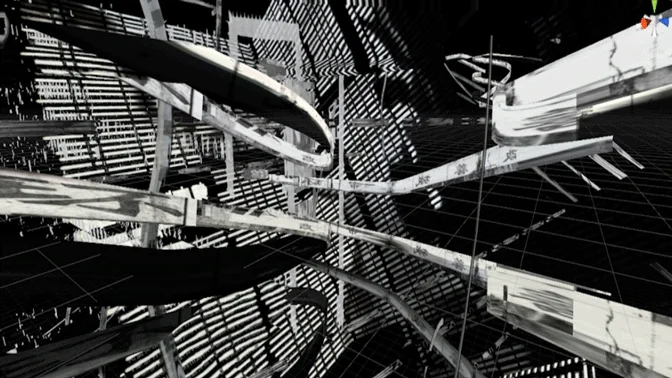
Our photographs usually sit apart from one another in albums, on phones, or in cloud storage. A Walled City transforms these personal fragments into a shared architecture. The image uploaded by a visitor is analyzed by a multi-agent AI system and turned into a virtual room; each new room joins with those that came before, becoming part of a growing city.
Developed by Weidi Zhang and Rodger Luo, the installation takes its architectural starting point from Kowloon Walled City in Hong Kong. Demolished in the 1990s, this dense settlement—with its complex structure that grew layer by layer without a central plan—defines the spatial logic of the work. The current version of the project is being shown in the ISEA Dubai programme in November 2026.
Why does a memory become a room?
Hanging an image on a wall is the most familiar way to display it. A Walled City, however, turns the image into an architectural volume, taking the visitor's memory beyond a surface that is merely looked at. The photograph's colors, objects, and associations seep into the room's form; personal content gains a permanent place in the city.
This transformation does not preserve the memory exactly as it is. The AI interprets the image, breaks it down, and reshapes it. The resulting room carries both the photograph uploaded by the participant and the system's decisions. The work thus shows that digital memory is never a neutral act of storage.
Is Kowloon merely an aesthetic backdrop?
Because of its cramped corridors and stacked structures, Kowloon Walled City is often used in popular culture as a cyberpunk backdrop. The project states that it moves beyond this visual appeal to focus on the settlement's decentralized mode of growth. The rooms are not placed by the command of a single master plan but by the decisions of agents that relate to one another.
Still, carrying the aesthetic and social complexity of a historical place into an AI model requires care. Kowloon was not just chaotic architecture; it was a neighborhood where real people lived, with legal ambiguities, solidarity networks, and harsh living conditions. The installation's success depends on its ability to discuss this past without reducing it to an image of "interesting density."
What does the multi-agent system do?
Instead of a single model generating the entire city, AI agents with different tasks interpret images, build rooms, and organize their relationship to the existing structure. This distributed structure allows the project to sustain its idea of a decentralized city at the technical level as well.
However, the system does not spontaneously create a neutral community. The agents' roles, training data, and settlement rules are determined by the designers. As in the example of the digital monument that grows with memories on Cinfikirli, participation takes place within boundaries drawn in advance by the infrastructure. Making these boundaries visible enhances the work's critical value.
Cinfikirli's reading
A Walled City does not use AI merely as an image-generating tool; it treats it like an urban planning system that connects the materials people leave behind separately. Therefore, the work's real question is not how impressive the visuals are, but how a private memory is represented in a shared space.
Digital platforms have also been classifying and juxtaposing our photos for years. What changes here is that this process becomes a visible architecture. When memories gain walls, corridors, and neighborliness, the algorithm's organizing power no longer stays in the background; it becomes a city you walk through.