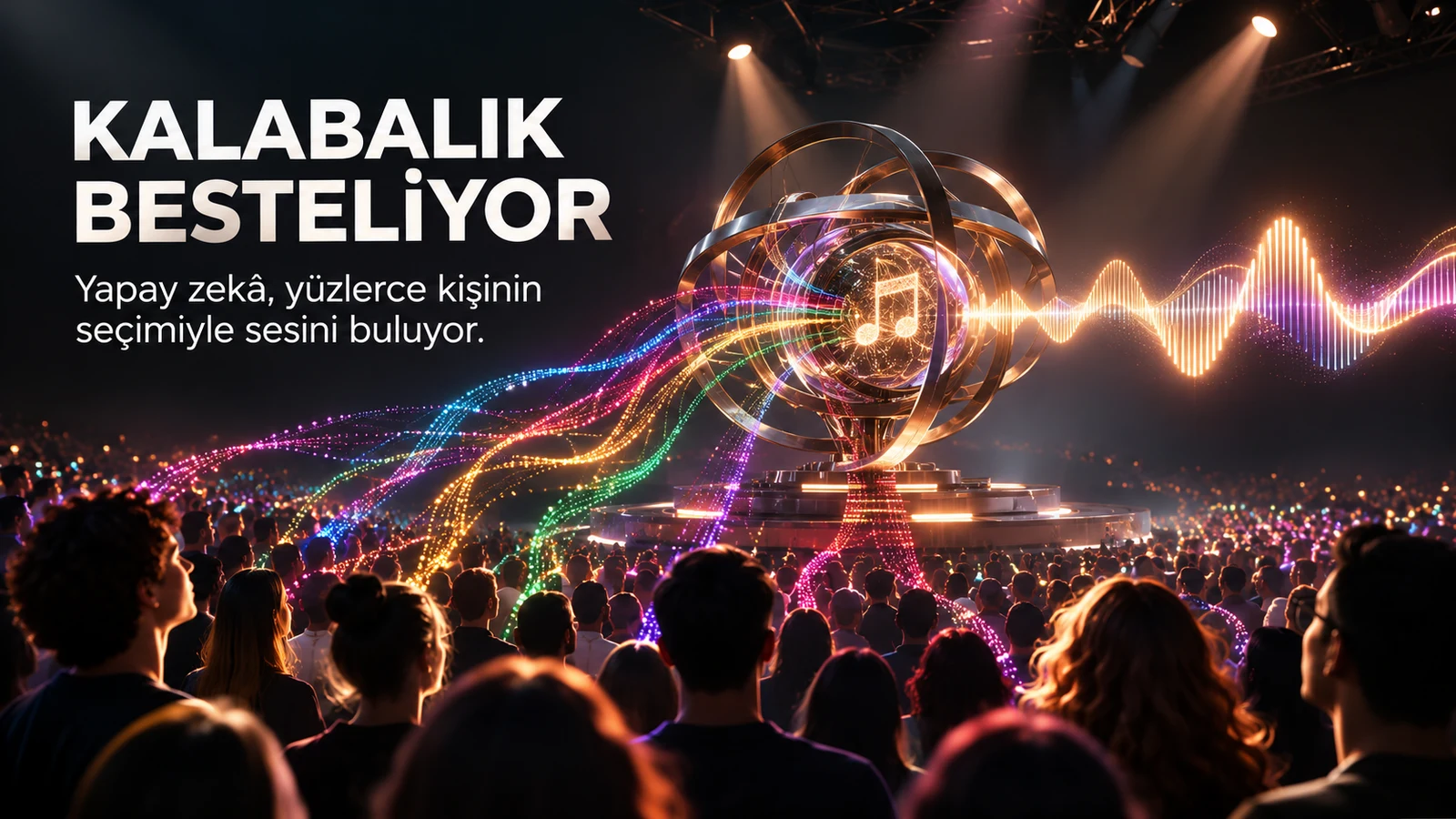
A concert crowd usually reacts to finished music. The Sound of the Crowd reverses this order: visitors' preferences become training data for a piece that is not yet complete. The installation, working with the archive of Sheffield electronic music group The Black Dog, takes AI music out of the realm of a single prompt and ties it to a collective decision-making process.
In the project developed for Festival of the Mind, visitors choose between different sounds. These choices guide the learning model built on research by Professor Guy Brown and Professor Nikki Dibben. The preferences accumulated throughout the exhibition contribute to the creation of a new piece at the live show on 14 November.
When the archive becomes raw material
The Black Dog's recordings, spanning decades, are not used here as a nostalgic selection. Rhythms, textures, and sound fragments are separated into material the model can work with. But which fragments will come to the fore is not solely the developers' decision; it changes with the small choices of the people touring the exhibition.
This also transforms the meaning of the archive. A music archive normally preserves works made in the past. Here, past recordings become the probability space of a piece that does not yet exist. The way digital archives recirculate cultural material, which we previously examined on Cinfikirli, turns into a dynamic production system in this project.
Is the crowd's choice really co-authorship?
Participants pressing buttons does not automatically make them composers. The model's boundaries, the sound pool, and how choices are weighted have all been designed in advance. Still, the visitor is no longer just a listener evaluating results; they make a small but real intervention in what the system should learn.
This distinction makes the question "whose work is it?" more useful in AI production. Instead of a single owner, there are different layers of responsibility: the musicians who created the archive, the researchers who built the model, the team who designed the interaction, and the visitors who steer it with their preferences. The final piece cannot be reduced to any one of these relationships alone.
Can taste be measured?
On most platforms, musical preference is inferred from behaviors such as listening time, skipping, and replaying. In Sound of the Crowd, however, choice is part of a public experience. People may decide not only based on their own ears but also on the visitors next to them and the context of the exhibition. Therefore, the data collected is not "pure musical taste" but a record of social behavior formed at a particular moment.
The project does not hide this flaw; on the contrary, it makes it visible. The model's music carries the variability of the crowd. The opening of an online version also adds the question of how the decisions of remote participants will meet in the same system as the physical exhibition.
Cinfikirli's reading
AI music is often discussed in terms of whether it will replace human producers. This installation suggests a more interesting possibility: the model could be a shared interface where people discuss their tastes, rather than an invisible machine producing finished songs.
Whether the result will be a good song is important, but not the only criterion. The project's real value is making the production chain visible. The crowd here is not just applauding; it leaves traces that determine which direction the machine will go.