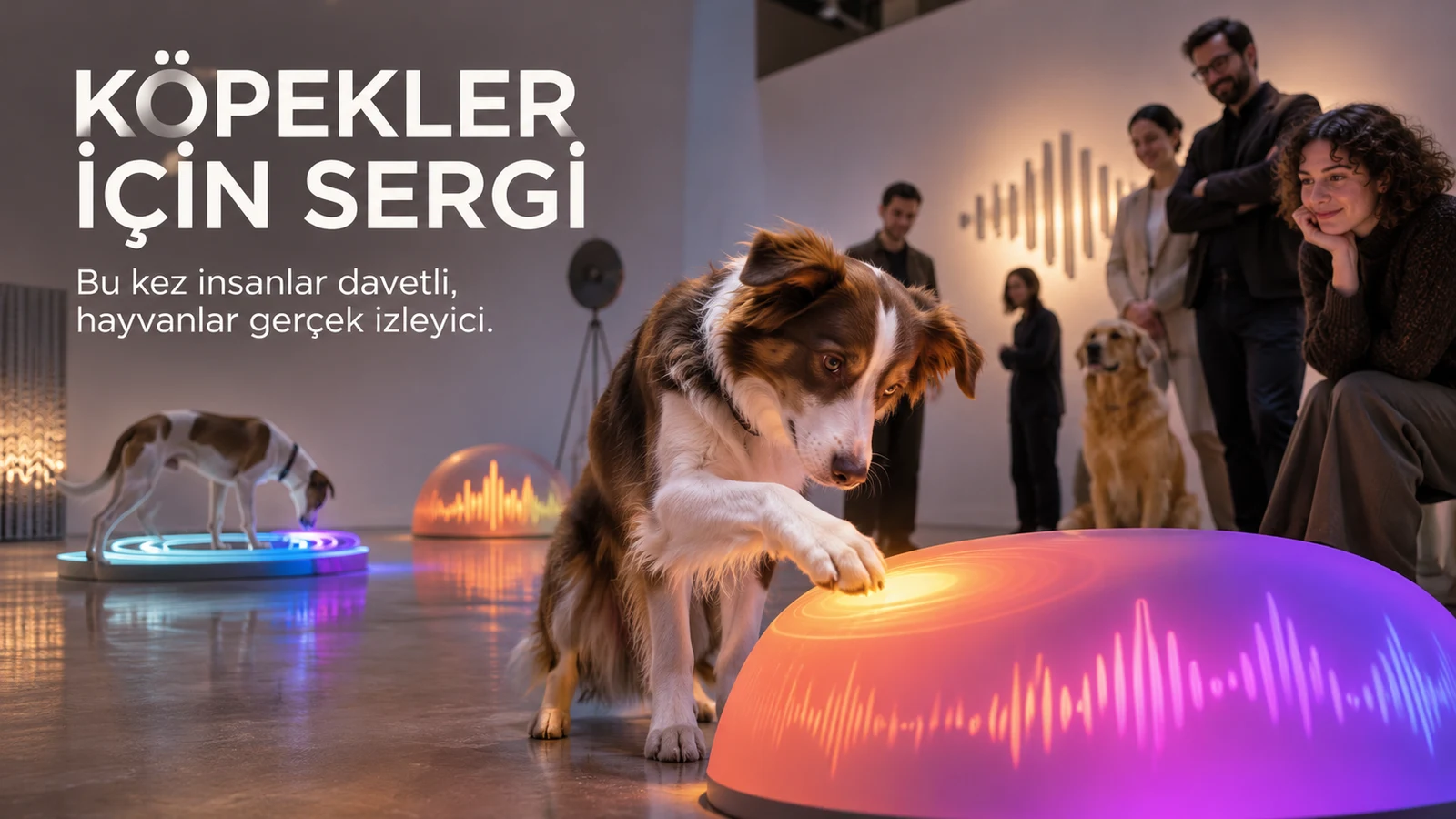
In art galleries, we often learn at the entrance what we cannot touch, where to stand, and how quiet we must be. woofy woofy ૮֊˕֊ა੭ bow-wow hauhau, to be shown in Dublin from 17–19 November 2026, rethinks these rules of conduct for a non-human audience. The main visitors of the installation are dogs.
Created by sound artist Gabriela Wacławska and Joe Rutland Walker as part of BETA Festival, the work allows dogs to freely play with toys and interactive objects. Their movements produce sound; thus play becomes a live performance rather than a command that triggers pre-composed music.
Humans are invited but not central
Each half-hour session admits five dogs and their owners. This limit is important not only for crowd control but also to allow the animals to establish a safe relationship with each other and the space. Humans accompany, but the meaning of the work arises not from their explanations but from the dogs' curiosity and movement.
In art history, animals have often been represented subjects, symbols, or material for performance. In this project, however, they are the audience and co-creators. Of course, the setup is still designed by humans; the dogs cannot choose to participate or set the rules of the work. Nevertheless, taking the sensory needs of the target audience seriously shifts the gallery's default human visitor from the center.
Play doesn't have to be useful
While developing the project, Wacławska focused on how dog toys encourage movement, curiosity, and interaction. The core idea of the installation is that in adulthood, play doesn't have to be productive, measurable, or aimed at a show. The dogs' behavior clearly demonstrates this: play continues for its own sake, not for a performance goal.
For the human audience, this situation may also create a slight discomfort. The dog may not press the expected button, may not be interested in the sounding object, or may only want to sniff the space. When the work does not see these "failures" as errors, interaction design moves away from an obsession with control.
Whose composition is the sound?
The dog's movement triggers the sound, but the artist prepares the sound pool and the response mode. Therefore, the result is neither entirely the animal's nor solely the designer's composition. The music emerges from the encounter between live behavior and a pre-established system.
This structure carries the common question seen in artworks that transform bodily data into visuals to another species: Does the system truly listen to the participant, or does it reduce them to a trigger for pre-written outcomes? woofy woofy's emphasis on open-ended play aims to leave a broader behavioral space for the dog.
Cinfikirli's reading
The appeal of the installation lies not only in the idea of "dogs making music." It shows that when we change the target audience of a design, the space, interaction, and success criteria must also change. A button that is understandable to a human may be meaningful to a dog because of its smell, texture, or movement.
This time, it may be the humans who want to direct the dogs immediately, not the dogs, who need to behave in the gallery. The work tests with a small and joyful experiment how far the promise of putting the audience at the center can really go.