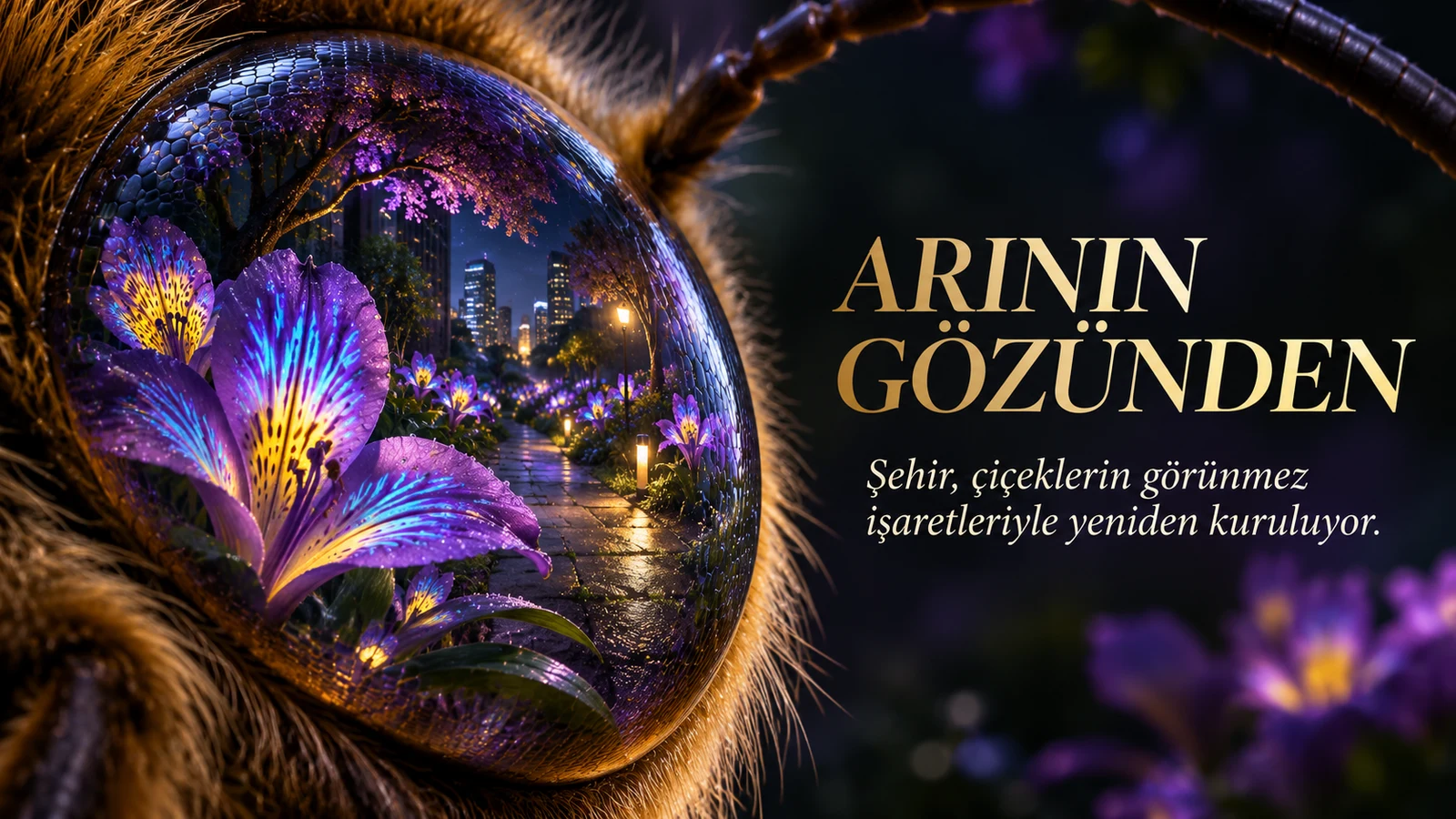
A flower may appear to the human eye as just a colorful surface. For a bee, the same surface is full of signs pointing the way to nectar. Be the Bee, opened as part of the Festival of the Mind in Sheffield, brings together sculpture, projection, and LiDAR scanning to bring visitors closer to this different perception.
The installation, prepared by Zoe Genders and Dan Conway, is based on Dr. Stuart Campbell's research on pollinator ecology. Visitors experience as a bodily experience the fragmented habitats, invisible flower signals, and connectivity problems within the city that a bee foraging on Sheffield's streets encounters.
Human vision is not all of nature
Humans perceive only a certain part of visible light. Bees, sensitive to ultraviolet light, can see patterns on flowers that we cannot detect. These patterns can guide the insect to the center of the flower like the approach lights of a runway. The starting point of the installation is to change the field of view itself rather than explaining this biological distinction in a technical info box.
This choice makes an important difference in science communication. Observing a creature from the outside is not the same as trying to approach its sensory world. Be the Bee does not promise visitors a full "bee vision"; however, it makes one feel that human perception is not the universal measure. Thus, the environmental issue is read not only through numbers but through what another creature finds and loses in the city.
Why is LiDAR used?
LiDAR scans the environment with laser pulses and converts it into a three-dimensional point cloud. In the installation, this method is used not so much to show Sheffield's familiar streets as a rigid architectural model but to turn them into a fragmented terrain through which the bee moves. Walls, roads, and gaps create different obstacles for humans than for a small pollinator searching for food within a few hundred meters.
Small green spaces that appear disconnected in city plans may be links in the chain of survival for a bee. When the distance between them increases or flowering periods do not overlap, this chain breaks. Projection and spatial sound transform the abstract disconnection on the map into a distance felt around the visitor.
Flower corridor as a design problem
The suggestion "Let's plant more flowers" may sound sufficient. However, species selection, flowering time, pesticides used, and connectivity between areas are at least as important as the number of flowers. Therefore, a pollinator-friendly city cannot be established solely through landscape aesthetics; the movement of different creatures must be part of the design decision.
The strength of Be the Bee is that it does not leave this relationship at the distance of a nature documentary. The visitor moves within a mechanism that changes their vision and scale. As with the interactive works that turn the body into a game controller we covered in Cinfikirli, here too the interface is not just a screen; it is the visitor's direction, distance, and attention.
Cinfikirli reading
This project does not use the word empathy as an easy emotional appeal. By acknowledging that it is impossible to exactly mimic another creature's perception, it makes the limits of design visible. Nevertheless, it opens up signals outside the human-centered city plan to experience.
Good science communication is not always about giving more information. Sometimes showing that our known perspective is incomplete is more effective. Be the Bee works not as a show that paints flowers in different colors but as a mechanism that asks through whose eyes the city is designed.