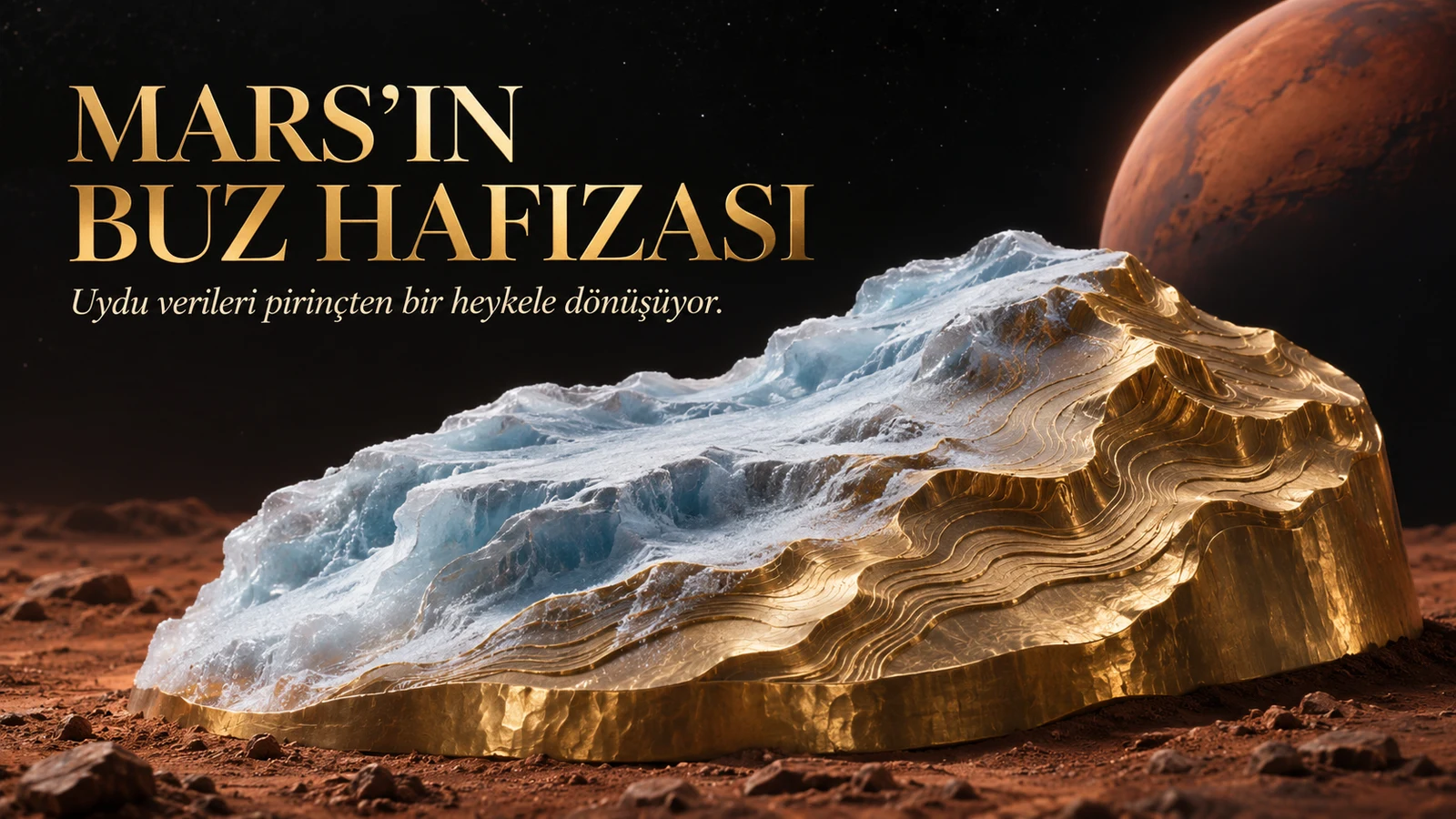
Mars’s glaciers are vast archives recording millions of years of climate change. Yet this archive is usually read through satellite images, colour-coded maps and elevation graphs. Space Glaciers offers another way of reading by transferring the same data onto the weight and surface of brass.
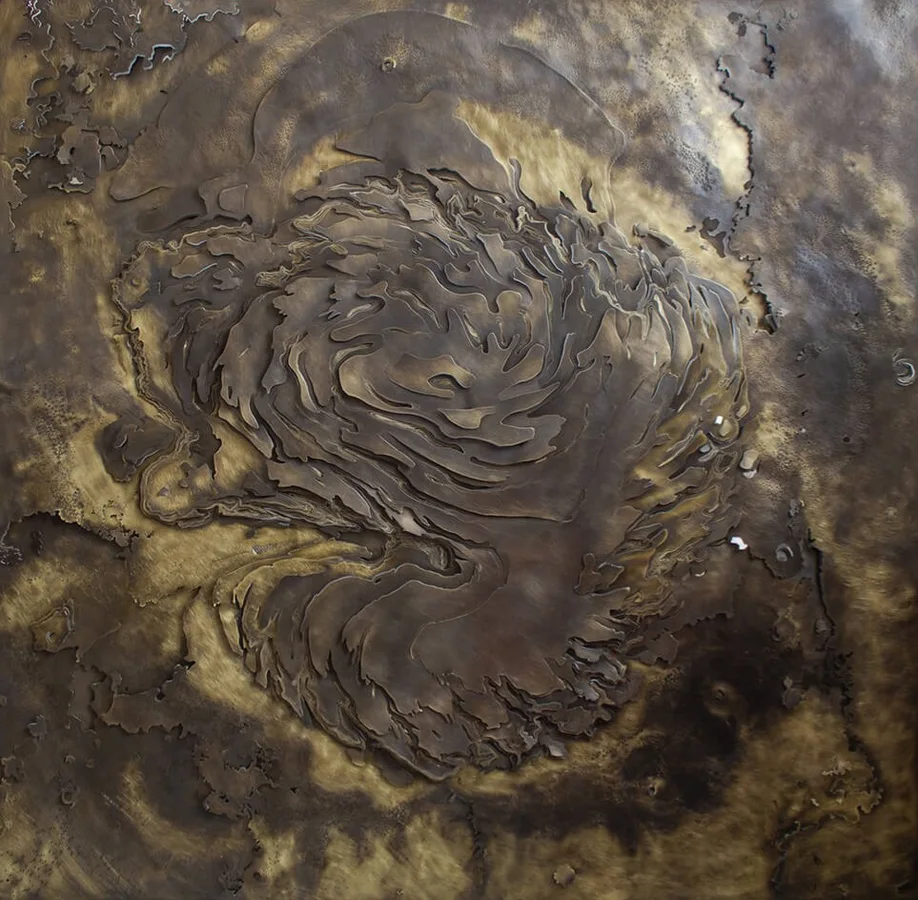
Developed by silversmith Holly Clifford in collaboration with planetary scientist Dr. Frances Butcher’s research, the sculpture draws on satellite images and elevation data of the Martian surface. The work is on display as part of the Festival of the Mind in Sheffield from 6–15 November 2026.
How does data become surface?
Although a satellite image may look like a photograph from afar, for researchers it carries information about surface shape, slope, shadow and layering. Clifford translates this topographic structure into elevations and depressions on metal. Thus, scientific measurement becomes an object that appeals not only to the eye but also to the hand.
The choice of brass is not accidental. The metal changes light at different angles; as it is worked, it retains marks and offers a long-lasting surface. Mars’s distant and cold geography is brought closer through the actions of hammering, cutting and polishing in the workshop. Data ceases to be a flawless digital surface and becomes a material map bearing traces of labour.
Why is ice the key to Mars’s history?
Although Mars appears dry today, its polar ice caps and subsurface ice deposits provide important information about the planet’s past climate. Layers of ice may carry traces of long-term changes linked to orbital variations and atmospheric conditions. Therefore, glaciers are not only a resource for future human missions but also the planet’s memory records.
The sculpture strives not to simplify this complex research into a decorative Martian object. The collaboration between scientist and craftsperson requires constant negotiation of which form represents what. Aesthetic decisions should not obscure the research; rather, they should open a new door through which viewers can approach the data.
The meaning of leaving the screen
Scientific visualisation is increasingly moving to higher-resolution screens and interactive models. Space Glaciers goes in the opposite direction. It subjects digitally obtained data to a slow, physical and difficult-to-reverse production process. This slowness is also in tune with the timescale behind the data: Mars’s glacial past is too long to fit into a few seconds of animation.
Unlike the interactive works that turn motion into image on Cinfikirli, here the data is concentrated in a static object. Visitors do not press a button; they participate by reading the layers of the surface and the details that change with light.
Cinfikirli’s reading
Information design is not only about producing clear graphics. Sometimes it is about finding the right material to convey the scale, weight and time of information. Space Glaciers does not use scientific data as an ornament for art; instead, it brings the decisions of craft together with the structure of research.
The resulting object is not a scaled-down model of Mars. It is more like a re-reading by human hand of measurements from a distant world. When data that we might scroll past on a screen is transformed into a permanent surface in metal, the time we spend looking at it also changes.