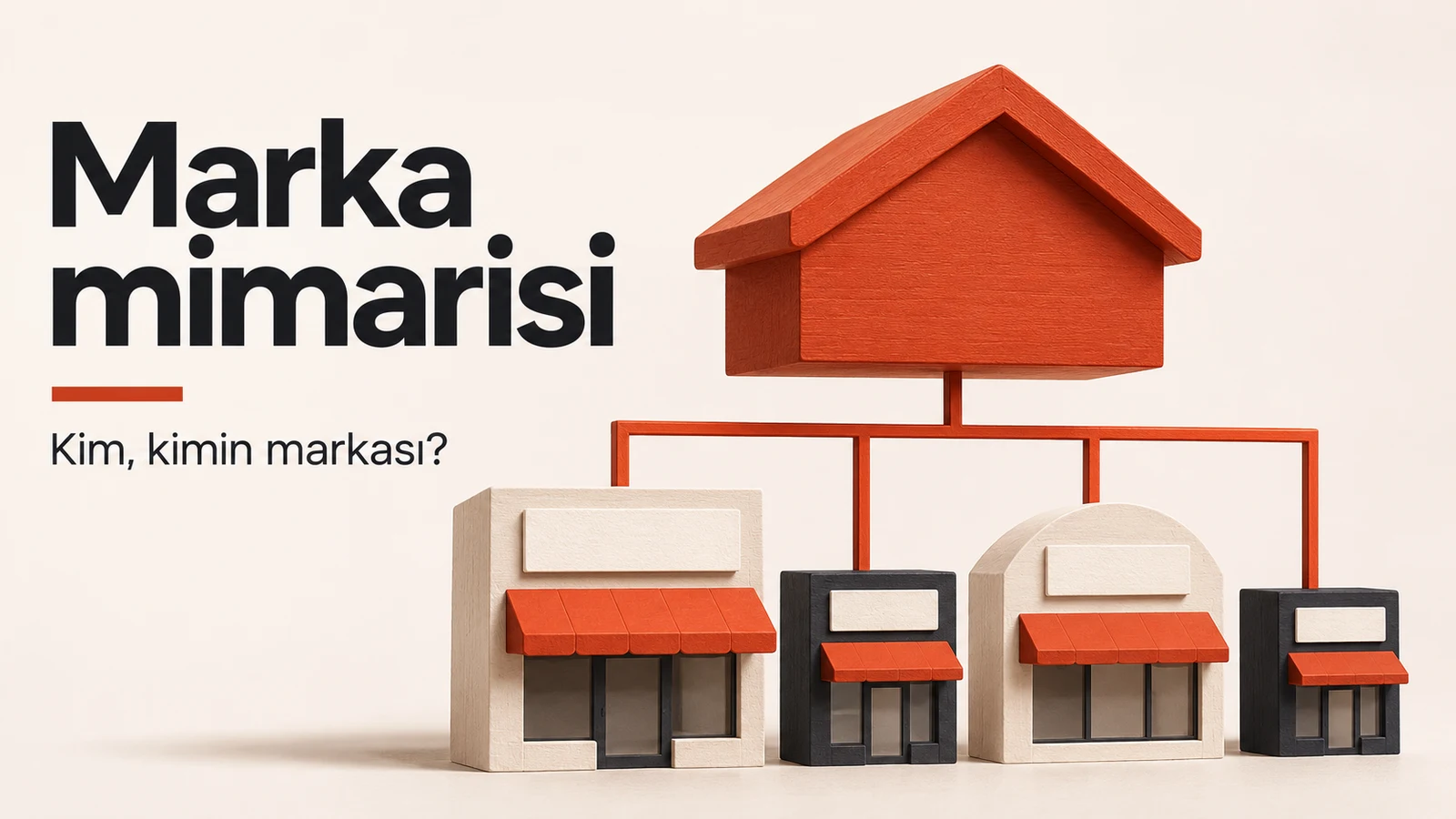
A detergent, a toothpaste, and a razor can all be products of the same company. But they don't appear on the shelf under the same name. At another company, a phone, a watch, and headphones may do different jobs, yet they immediately signal that they belong to the same brand family. This difference doesn't come from logo design alone: it's a decision about how brands connect to one another.
What is brand architecture?
Brand architecture is the structure that organizes the relationship between a company's master brand, sub-brands, products, and services. It determines which name comes to the fore, which products share a common identity, and which speak under their own name.
Brand architecture makes the relationship between the names customers encounter clear. Whether to present all of a company's activities under a single name or to build a separate brand for each product group is the subject of this field. Neither can be said to be always better than the other.
The difference between brand architecture, brand strategy, and brand identity
Brand strategy defines whom a brand speaks to, with what promise, and from what position. Architecture looks at how multiple brands or product families relate within this structure. Identity is how these decisions are expressed through name, visual language, voice, and other recognizable elements.
Concept | Question it answers | Example decision |
|---|---|---|
Brand strategy | For whom, why do we exist? | Should we emphasize affordability or expertise? |
Brand architecture | Which names, in what relationship, will be presented? | Will the new service launch under the master name or as a separate brand? |
Brand identity | How will we be recognized? | Name, logo, color, typography, and tone of voice. |
For core positioning decisions, the brand strategy guide offers a broader starting point. Mistaking architecture for merely lining up logos can reverse the order of these decisions.
Main brand architecture models
The models describe the closeness between the master brand and other names. Sources sometimes classify sub-brands as a separate model, sometimes as a variant of master-brand-led structures. The four headings below are a framework for understanding the topic; they are not an official classification that divides companies into fixed boxes.
1. Master-brand-led structure: Branded house
In the branded house model, products and services are presented under the name and reputation of a dominant master brand. The aim is to show that different offerings come from the same family.
To understand this structure, one can look at Apple's Mac, iPad, iPhone, and Watch product families. Product names differ from one another, but the Apple identity forms the common frame. Here, treating the iPhone merely as a model name or as a company brand entirely independent of Apple oversimplifies the relationship.
A shared name can make it easier to transfer recognition from one product to others. On the other hand, a loss of trust in one category can also affect offerings that carry the same name. The master brand must credibly accompany the promise of every new product.
2. Independent-brands-led structure: House of brands
In the house of brands model, different brands are presented to customers under their own names, promises, and identities. The owning company's name is not always the star in consumer communication.
Ariel, Gillette, and Oral-B in P&G's portfolio can be used to illustrate this distinction. Customers do not choose detergent, shaving products, and oral care under the same brand name. Shared ownership does not mean the brands carry the same personality on the shelf.
Separate brands can speak more distinctly to different audiences and price expectations. In return, each requires building recognition, producing content, and maintaining communication. Using separate names does not completely separate all legal or reputational risks from one another.
3. Master-brand-endorsed structure: Endorsed brands
In this model, the offering keeps its own name; the master brand accompanies it as a visible endorsement or mark of trust. There is a relationship between the names, but one does not completely erase the other.
The naming Courtyard by Marriott in Marriott's portfolio makes this relationship visible: Courtyard remains a separate name while the Marriott connection is also communicated to the customer. This example does not mean that Marriott's entire portfolio consists of a single model.
How large or small the endorsing name is written is a design decision; what the endorsement means is a brand decision. If the customer does not understand the link between the two names, simply adding a second logo may not be enough.
4. Hybrid structure: Hybrid
The hybrid model is the use of different relationship types together within the same portfolio. Some offerings may carry the master name while others are presented with endorsed or more independent identities.
Acquisitions, different target audiences, and new business areas in particular can give rise to multiple structures in a portfolio. The problem with the hybrid model is not diversity but decisions made without rationale. It must be determined when a new brand will be opened, when a shared name will be used, and who will approve exceptions.
Let's compare the models at a glance
Structure | What does the customer see? | Potential advantage | What to watch for |
|---|---|---|---|
Branded house | A strong shared master name | Benefiting from shared recognition | The master name's fit for every offering |
House of brands | Distinct brand names | Making room for different positionings | Each brand's need for maintenance and communication |
Endorsed brands | A separate name and visible master brand endorsement | Using shared trust while differentiating | Clarity of what the endorsement means |
Hybrid | Multiple relationship types | Adaptation to different portfolio needs | Consistency of decision rules |
Does a new product need a separate brand?
A new product does not automatically require a new brand. First, it is examined whether the customer can make sense of this product under the existing name and whether the new offering carries a different promise.
Let's imagine a hypothetical coffee business: "Kıyı" sells packaged coffee and brewing equipment. When the business starts offering coffee service to offices, a descriptive name like "Kıyı Office" may be sufficient. However, when it enters another business with different price, distribution, and customer expectations, it might consider the separate name option. This is an example of a decision; it is not a recommended model for every business.
Before deciding on a new name, the following questions can be answered:
Do existing customers expect the new offering from the same brand?
Do the promise, price, and experience support each other?
Are there resources to introduce and sustain a separate name?
Does the master brand's reputation genuinely contribute to the new offering?
Does this decision establish an understandable rule for the next product as well?
Where to start a brand architecture study?
The first step is not to draw a new logo but to record existing names and relationships. It is examined whether product, service, company, campaign, and brand names are mixed up in the same list.
Take inventory: Write down the names used, which customers they address, and where they appear.
Research actual perception: The relationship understood internally may not be the same as the one understood by the customer. Test this difference through interviews and research.
Compare alternatives: Discuss the costs and expectations of shared name, endorsed name, and independent brand options.
Set the rules: Clarify responsibilities for naming, brand endorsement, new products, and post-acquisition use.
Plan the transition: Address changes in packaging, store, website, and customer communication together.
Once these decisions are clear, the creative brief prepared by the design and communication team will also be clearer. The brief will not have to close an unresolved brand relationship with visual arrangement alone.
Three most commonly confused points
A company chart is not brand architecture. A diagram showing legal ownership does not have to match the name order the consumer sees.
Not every different name is an independent brand. Product variants, model names, and campaign names can also differ. One should look at how the names are used and what expectation they carry.
There is no single correct model. The goal is not to have as many brands as possible or to make all logos identical; it is to enable the customer to distinguish offerings and understand the link between them.
Sources and scope of examples
Model names are used as an explanatory framework. Real brand examples are based on official portfolio and product pages checked on November 8, 2026; they are not an audit covering all of the companies' activities.