There is often a distance as tangible as furniture and as invisible as the language of welcome between a cultural institution saying it is accessible and actually being accessible. To close this gap, Rotterdam's MaMA has launched a two-year research project that places neurodivergent visitors at the center of decision-making instead of applying a ready-made checklist.
Neuroinclusive Co-Creation Lab positions eight neurodivergent participants not as a temporary group conducting "user testing" but as co-researchers working from September 2026 to September 2027. Six members of the group come from outside the professional arts and culture field, while two come from within the sector. Thus, the experience of those already familiar with institutions does not overshadow the experience of those who struggle to enter cultural spaces.

Neuroinclusive Co-Creation Lab announcement visual. Image: MaMA. Source
Why isn't a "low-stimulus room" enough?
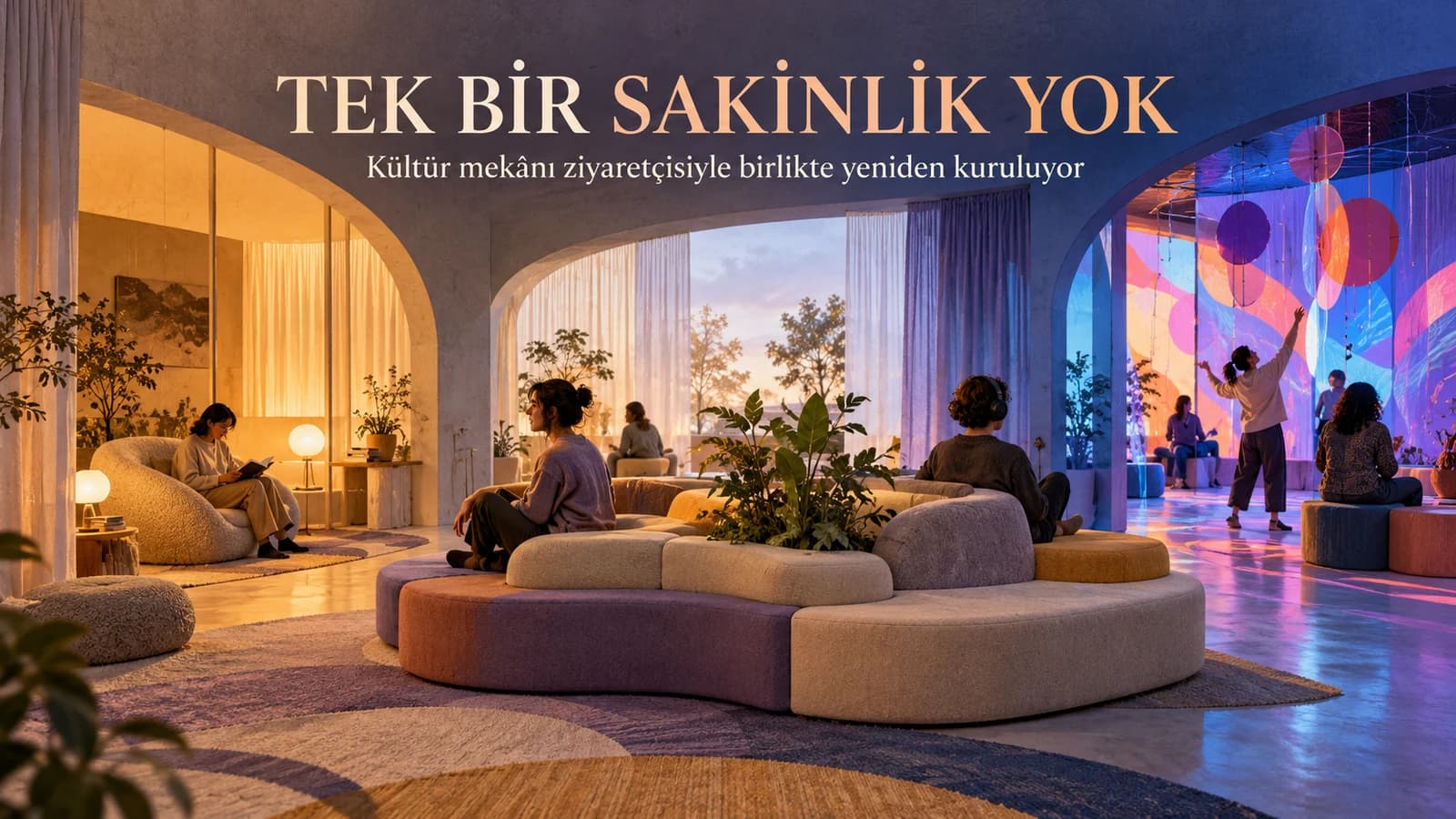
The project's first public experiment was the Resting Space set up in MaMA's exhibition area throughout October. However, the team deliberately did not call it a "low-stimulus area." Because silence, dim light, and stillness do not produce the same comfort for everyone. While some people may find sound or movement regulating, the same conditions can be exhausting for others.
Although this distinction may seem small, it changes the fundamental assumption of design. The traditional accessibility approach produces fixed solutions for a predefined average need. MaMA's experiment, however, questions the average itself. Light, sound, and layout are changed weekly based on the experiences shared by visitors. The goal is not to find the perfect rest room but to learn how different needs can be negotiated in the same space.
Not a participant, but a decision-making partner
The promise of co-design is often used, but it is not always clear which decisions are actually opened to participants. In this project, neurodivergent co-researchers determine which questions will be addressed, which topics will be tested, and how conclusions will be drawn from experiences. In addition to monthly meetings, five workshops open to a wider group of participants are planned, reducing the problematic expectation that a single representative can speak for all neurodivergent experiences.
Moreover, the research is not limited to the physical space. How an event is announced, what social behaviors are expected from visitors, how they are greeted at the entrance, and at what pace the program flows are also considered part of accessibility. This approach does not see design as merely walls, light, and furniture; it treats the institution's language and working order as a designable system.
Accessibility is not a fixed feature
The dimensions of a ramp can be determined, but sensory and cognitive needs cannot be standardized with the same precision. This does not mean standards are unnecessary. On the contrary, it shows the need for feedback loops that make visible the experiences standards cannot capture. The weekly change of the Resting Space is therefore not a decor refresh but a learning method through which the institution regularly tests its own assumptions.
The tactical design that transforms school environments according to children's movement, which we previously examined in Cinfikirli, touched on a similar point: good design changes when it includes the user in the definition of the problem rather than measuring them at the end. The neuroinclusive lab extends this idea to all touchpoints of the cultural institution.
The limit of "design for all"
"Design for all" can be a well-intentioned but dangerous promise. When it assumes everyone will be comfortable with the same solution, it renders differences invisible again. The language MaMA uses is more measured: instead of promising a single perfect space, it explores together which choices exclude whom. The fact that visitors do not have to explain why they want to rest is also an important detail of this approach.
At the end of two years, the project plans to publish practical recommendations for the cultural sector and art education. However, the conclusion that can be drawn already is that accessibility is not a feature that is delivered and finished. Space, communication, and program must be reconsidered together with visitors' changing needs. Therefore, the real product of neuroinclusive design may not be a single room but an institution capable of changing in response to feedback.
This case reminds us that design is a distribution of decisions before it is aesthetics. Who speaks, whose experience counts as knowledge, and which discomfort does the institution accept as "normal"? The co-design lab does not offer a single visual solution to these questions; it redistributes the right to decide. As we also saw when discussing how digital culture codes design habits, whether the interface is a screen or an exhibition hall, it silently describes the behavior expected from the user.
MaMA's experiment proposes a more laborious path instead of well-intentioned but fixed accessibility packages: listening, changing, and accepting that the same solution will not work for everyone. Perhaps a truly inclusive cultural space is one that never declares itself complete.
Communication design is as decisive as space
Before a visitor reaches the building, they encounter the program text, ticket flow, email, wayfinding, and social media announcement. Clearly explaining how long the event will last, what kind of sound or light will be present, and whether it is possible to leave the space if needed can be more decisive for some visitors than the physical arrangement. It is therefore important that the project includes communication and welcome practices in its research. Accessibility is not a separate service that begins at the door; it is an information architecture that affects the visitor's decision-making process from start to finish.
This perspective also tests the frequently used phrase "everyone is welcome." Saying welcome does not eliminate invisible expectations about which behavior the visitor will display. Social rules such as how much to talk, whether to make eye contact, how to ask questions, or whether leaving an event early is considered rude can make access to the space difficult. Co-design makes these rules a visible topic of discussion instead of accepting them as natural and unchangeable.
Another way of measuring
Cultural institutions are accustomed to measuring success through visitor numbers, occupancy, and satisfaction surveys. The neuroinclusive approach adds questions like "who didn't come, who left early, who got tired at what moment and why?" alongside "how many people came?" These data cannot easily be converted into a single score; they require regularly listening to qualitative experiences. The long-term participation of eight co-researchers provides the opportunity to see changes that a one-time survey cannot capture.
Yet co-design does not automatically produce equity. Participants' labor must be compensated, their decisions must actually be implemented, and the institution must not select only comfortable outcomes. The fact that MaMA's open call specifies a fee per meeting is a concrete detail in this regard. Sharing experience is not a free raw material; it is recognized as expertise and labor. The value of the project will be understood by how well it can carry this principle into institutional practice over two years.