You open a transportation app, your expectations are clear.
You type where to be picked up. You type where to go. The car arrives. You get in, you go. The whole point is a journey without surprises. A clean car. A clear price. An estimated arrival time. A driver rating. The more invisible the service, the better it works.
Uber Drift does the exact opposite.
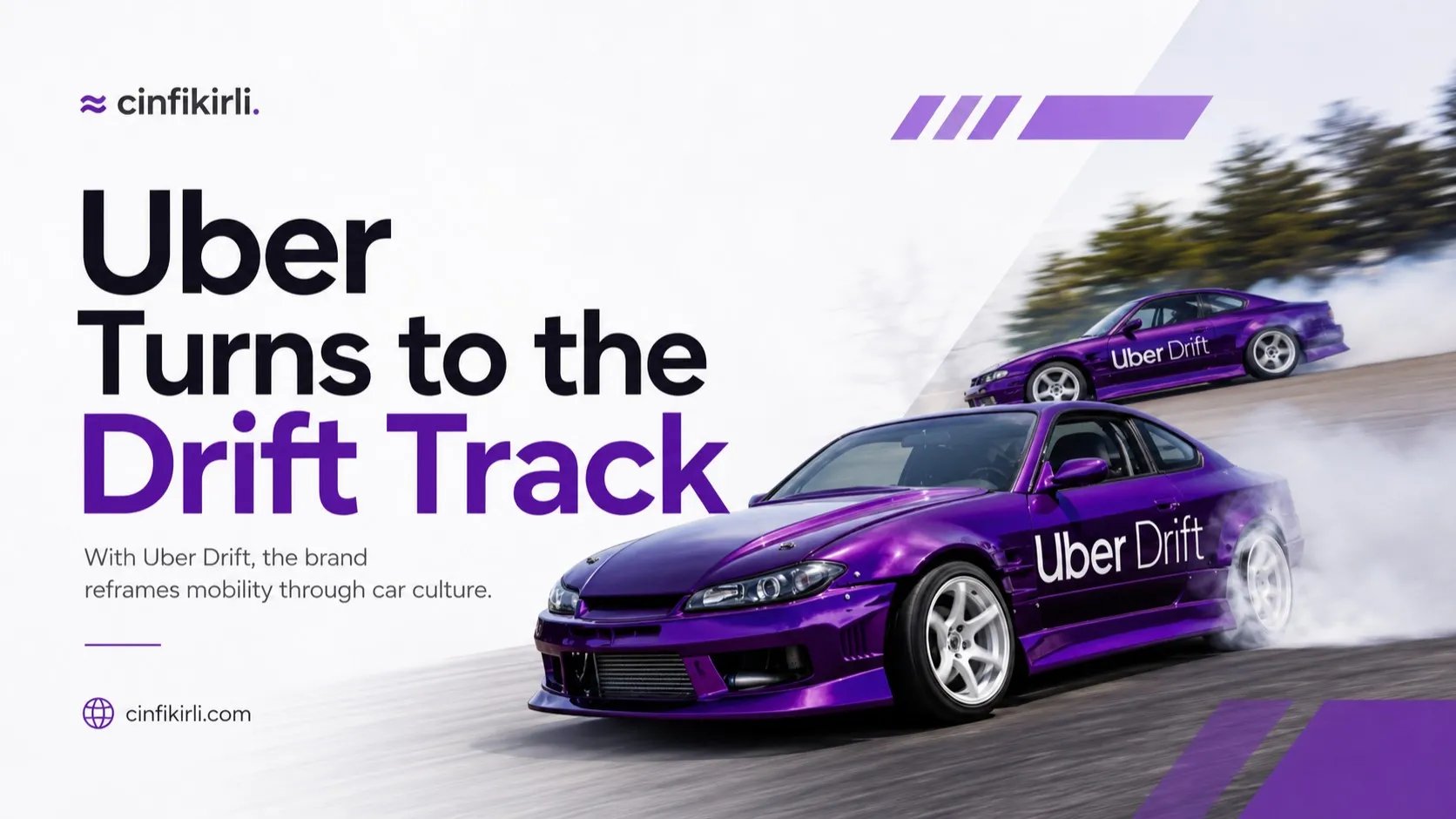
Uber is launching a limited-time experience in Japan from June 3 to July 1, 2026: passengers are picked up from their accommodations in Tokyo by Uber Black, taken on an approximately 90-minute journey to Mobara Twin Circuit in Chiba, and experience drifting in a Nissan Silvia S15 and Nissan 180SX alongside Formula Drift licensed professional drivers. The price is 30,000 yen per group; only four groups are accepted per day.
The point here isn't "Uber is selling a track experience."
The point is this: Uber is redefining its most ordinary behavior — hailing a car through the app — by connecting it to one of the most inaccessible fantasies of Japanese car culture.
Not hailing a car from the app, but hailing a fantasy
Uber's daily promise is simple: Getting from one place to another.
But where the brand wants to grow isn't always "more cars." Sometimes it's more meaning. Because at a certain point, all transportation apps start to look alike. There's a map. There's a driver. There's an arrival time. There's a button. A little cheaper, a little faster, a little more comfortable.
Okay, and then?
Then the brand just becomes a logistics service. It does its job but doesn't leave a mark in your mind.
Uber Drift opens a different door here. It doesn't tell people "Hail a car in Tokyo." It says "Step into drift culture in Tokyo." And it does this without breaking the app's own behavior: you still reserve through the app, the car still picks you up, you're still taken somewhere. But this time, the destination isn't an address, it's a cultural scene.
Let's call this a "reservation-ready fantasy."
Here's the definition: Making a normally hard-to-access, closed, local, or subcultural experience accessible within the brand's existing service flow.
That's the power of Uber Drift. Because for an outsider tourist, Japanese drift culture might just look like a "Tokyo Drift" poster. You see it in movies, games, YouTube clips, Initial D nostalgia. But getting into the real scene isn't easy. Where is it done? Who takes you? Is it safe? Is it legal? How do you, as a tourist, get involved?
Uber reduces this uncertainty to a single button.
This isn't transportation. It's being a cultural intermediary.
Packaging a subculture is hard work
Some cultures die the moment you package them.
Drift is one of them. Polish it too much, and it turns into a tourist show. Sterilize it too much, and its soul escapes. Describe it too much as a "premium experience," and the smell of hotel lobby clings over the scent of burning rubber, engine noise, and the feeling of risk. And if the brand talks too much, it immediately turns into an advertising backdrop.
Uber's toughest test here is this: Turning Japanese drift culture into a safe and legal experience without softening it too much.
This experience is still controlled but intense: there are professional drivers, a track environment, mandatory helmets and safety gear; but the ambiance doesn't feel like an overly sterile tourist trip. A technical track like Mobara Twin Circuit, cars with a strong place in JDM memory like the Nissan Silvia S15 and 180SX, and the tandem drift structure take it beyond being a "themed car ride."
No, it's not just about fast cars.
No, the phrase "adrenaline-filled experience" isn't enough either.
No, you can't just slap a Tokyo sign on it with a few neon effects and call it a day.
The real issue is how close the brand gets to the subculture.
Uber doesn't take the driver's seat here. It doesn't put the passenger in it either. It chooses its role correctly: it becomes the intermediary that takes you to that scene.
This is important.
Because some brands, when they enter a culture, immediately want to take the lead role. They brand everything. They put logos on every surface. They turn the subculture into their own campaign set. Then, all that's left of the culture is a costume.
In Uber Drift, the brand acts smarter. It makes the experience bookable, but it doesn't claim ownership of drifting. It doesn't say "We are drift." It says "We put you inside drift."
The difference is huge.
Go Anywhere: the side door of the transportation promise
Uber Drift is noted as the first application of the brand's Go Anywhere series in the Asia-Pacific region. This series tries to transform Uber from just a city transportation app into a gateway to selected experiences. According to Top Gear Philippines, Go Anywhere has previously included examples like safari tours in South Africa and hot air balloon experiences in Turkey.
The strategy is clear.
Uber's core is movement. But if movement is only read as "transportation," the brand narrows. Movement can also be escape, adventure, city exploration, cultural entry, tourist experience, even a personal story.
Go Anywhere expands this space.
A&W Canada had crushed a restaurant for its smash burger launch, bringing the verb in the product name down to the physical space. Oatly had opened a Bike Thru in Amsterdam, translating the drive-thru format to a bike city. VIA Rail had turned the stitching of a baseball into a train track, capturing the route between two cities in a single object. Uber, here, is turning the idea of a "journey" into a cultural experience passing through the track.
We're talking about the same lesson.
What does the product do?
Uber takes you.
And where to?
Normally, to an address.
Here?
Into a fantasy.
Good activation sometimes doesn't expand the product promise. It finds the most exciting address that promise can go to.
Rarity is half the experience
Another critical aspect of Uber Drift is capacity.
Four groups per day. Very limited seats in total. 30,000 yen per group. Pickup from Tokyo, drift experience at the track, then return. So this isn't an open, infinitely scalable campaign for everyone. It's something deliberately kept narrow.
This is also strategic.
Because some experiences lose value when they become too accessible. What everyone can do at the same time ceases to be an object of cultural curiosity. Uber isn't acting like a mass campaign here; it's opening a limited window. The narrowness of that window also increases the buzz.
Does this sound familiar?
"Limited spots."
"Last day."
"Don't miss out."
"First come, first served."
"While stocks last."
These sentences are usually used as a marketing reflex. Most of the time, they smell like a cheap pressure tactic.
But rarity works differently when it's real.
In Uber Drift, rarity comes from the nature of the operation. The track is limited. The driver is limited. Safety is limited. The number of groups is limited. Because the experience itself is limited, the word "limited" doesn't feel like a marketing gimmick.
Don't miss this distinction.
If you try to sell artificial scarcity, the consumer will smell it. If you establish real scarcity, the experience becomes an object of desire.
Here, what Uber is doing is turning a transportation service into an object of desire. Normally, calling an Uber isn't something anyone would tell their friends about. But the sentence "I called a drift experience from Uber in Tokyo" becomes a story.
And that's often what brands are after: turning a service into a story.
Would it work in Turkey?
A direct equivalent of this idea in Turkey is difficult.
The reason is simple: Offering a high-risk, technical, safety-regulation-demanding experience like drifting through a transportation app isn't just a matter of creative ideas. You need a track. You need licensed drivers. You need insurance. You need a legal framework. The operation needs to run flawlessly. And the brand needs to give the confidence that "we can really control this."
But the essence of the idea could work in Turkey.
Not "Uber Drift" itself, but the idea of "making an inaccessible local fantasy bookable through a transportation app."
For example, in Istanbul, there are some city experiences that everyone sees from the outside but can't get into. A sunrise route on the Bosphorus. The morning preparation of the Grand Bazaar. The hours of the historical peninsula before the tourist crowds. The inside of a specific craft workshop. The controlled scene of a sports culture. The back kitchen of a food ritual.
There's no need to make up names and say "that brand did it." The issue isn't brand examples, it's the logic.
Would this work in Turkey?
It would, but not by saying "let's sell an experience." That's still a whisper.
For it to work, the brand needs to answer this question: Which piece of local culture that people watch from afar but can't enter can we make safely, respectfully, and authentically bookable?
This question is good.
Because it contains culture, operation, and brand role.
It's not a simple "let's make a tourist package."
Which door does your brand open?
It's easy to see Uber Drift as just a fun tour for car enthusiasts.
But if you read it more broadly, there's a very clear lesson for the brand: Connect a service behavior that users already know to a cultural door they don't expect.
Uber's behavior is clear: call, get in, go.
Uber Drift doesn't break this behavior. It just changes the destination. Fantasy instead of an address. Story instead of a transfer. Cultural gateway instead of a vehicle.
Is this possible for your brand?
Does a finance app just process payments, or does it open opportunities people can't access?
Does a food brand just take orders, or does it make local food rituals visible?
Does a travel brand just sell routes, or does it open a proper entrance to cultures people watch from afar?
Does a tech brand just provide convenience, or does it open worlds that seem closed to the user?
That's the real question.
No, not everyone needs to do experiential marketing.
No, not every brand will find a track and drift cars.
No, not everything has to be "adrenaline."
But every brand should ask this: Is my service just a transaction, or is it a door?
Uber Drift gives a loud but clear answer to this question.
Sometimes a good brand move isn't about taking the user somewhere. It's about opening the door to a world the user has been looking at from the outside for years.