When a brand launches a new burger, you probably already know what you're going to see.
Close-up shots of meat. Melting cheese. Brioche bun. Sauce dripping from above. The crunch of pickles. And a headline: "A new flavor has arrived." Or maybe a hungrier version: "Rediscover the burger experience." The photo might be beautiful. The product might be good. But the idea often stays on the tray.
That's why what A&W Canada did with its smash burger launch is worth talking about.
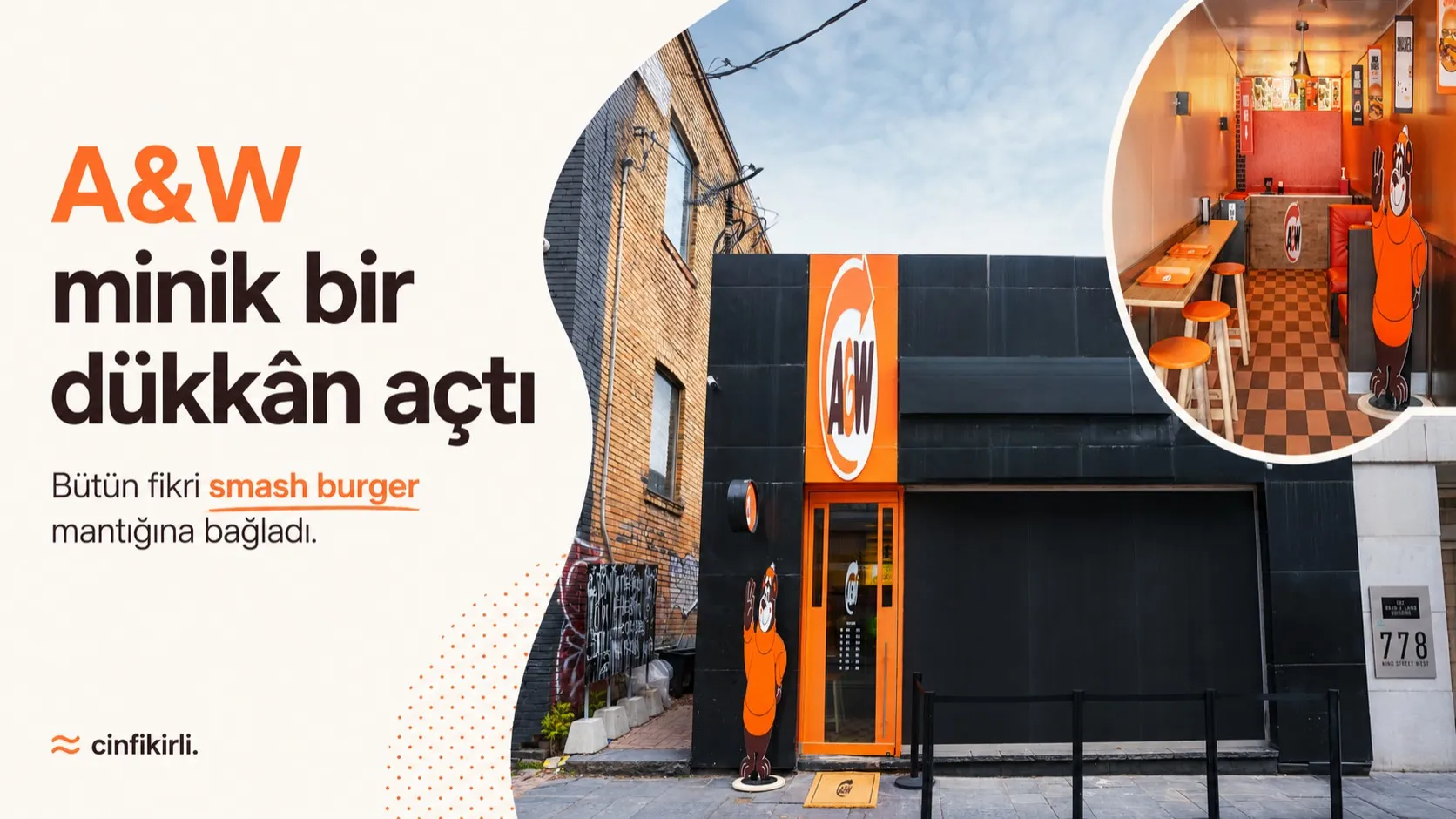
For its first national smash burger launch, instead of leaning on a classic product photo, the brand turned one of its Toronto restaurants into a "crushed" pop-up for a day. The facade looked caved in, the furniture looked pressed down, and the service trays, signage, and even the mascot Rooty were designed to look flattened. The campaign is by Rethink; the pop-up took place on May 22 at 780 King Street West in Toronto, and the product went on sale across Canada starting May 25.
The point here isn't "they squished the restaurant."
The point is this: A&W took the word from the product name out of being just an ad headline and turned it into a physical experience.
Writing the word is easy; making it live is hard
A smash burger already has a built-in action.
Crushing.
Pressing.
Squashing.
Spreading on the surface.
Most brands would keep that word just in the product name. "New Smash Burger now in our restaurants." Done. Maybe a few line effects next to the logo. Maybe some explosive typography on social media. Maybe a more aggressive font on the packaging.
A&W didn't do that.
They took the word and applied it to the restaurant.
Let's call this a "physical wordplay."
The definition: making the action in the product's name or promise physically happen in the ad itself.
That's the power here. Because the word "smash" isn't just explained; it becomes visible on the restaurant's facade, on the chairs, on the trays, on the mascot, on the signage. So the idea doesn't look like a visual effect. It enters the restaurant.
Okay, but why does it matter?
Because fast food launches often rely too much on the beauty of the product. As if everyone will lose their sense of direction and rush to the branch just by seeing a new burger photo. No. People see burgers every day. They see sauce. They see cheese. They see flame effects. They see "limited time." Their eyes have gotten used to it.
To break that habit, a more appetizing photo alone isn't enough.
Sometimes you need to break the space.
Controlled chaos instead of a beauty shot
The old reflex in fast food advertising is beauty.
The burger stands perfectly. The bun shines. The lettuce doesn't spill over. The meat layer is flawlessly aligned. The sauce drips exactly where it should. Everything looks too calm, too polite, too sterile for a photo shoot.
A&W's work goes the opposite way.
In the world built by Rethink, crushed packages, crumbs, crooked surfaces, and objects that look like a giant press rolled over them take center stage. According to Creapills, creative directors Skye Deluz and Shannon McCarroll describe the campaign as "as smash as possible"—meaning it's not a polished product tribute, but a visual chaos born from the product's cooking logic.
This is a good decision.
Because a smash burger isn't a refined food language. It's a burger type pressed onto the pan surface, with crispy edges and a bit of messiness that whets the appetite. So if the ad were too clean, it would contradict the product.
Here, the brand seems to have asked itself:
"What is this burger's behavior?"
Answer: To crush.
So how?
Crush the restaurant too.
That's it.
Simple but right. That's how some of the best activations work. They don't write big strategy sentences. They amplify the simplest action within the product.
Burger King played with fire for years because flame-grilling was at the center of its product narrative. IKEA spread the idea of making small spaces livable into the store experience, catalog language, and even apartment life humor. Liquid Death took water out of the "healthy living" packaging and into concert aesthetics. Snickers told hunger through personality changes. And here, A&W is taking the word "smash" from the burger to the restaurant scale.
So product behavior becomes campaign behavior.
A one-day pop-up sometimes speaks clearer than a 30-day film
It's also important that A&W did this through a pop-up set up for just one day.
Because some ideas want to be an event rather than a commercial.
In a film, you could show the restaurant being crushed. You'd do it with CGI. An actor looks surprised. The camera zooms in. Then the burger appears. Clean work. Safe work. But it lacks physical reality.
A pop-up does something else. People can go there. Take photos. Go inside and see the details. They feel that the brand actually applied the word "smash" to the space. That's why this kind of work doesn't just buy media; it gives people something to show.
On pop-up day, A&W also offered visitors an early taste of the new burger. According to the official announcement, visitors could get a limited number of free Double Smash Burgers; the national launch started on May 25, with the product available in single or double options across Canada for a limited time.
Here, the product trial and the visual event connect to the same place.
It's not just "come and taste it."
It's "come and step into the word smash."
That's the difference.
The problem with most pop-ups is that they're just decor. A nice wall. A nice neon sign. A nice photo spot. But the connection to the brand idea is weak. People take a photo and leave. Then what was it? They don't remember.
A&W's work isn't decor; it's the spatial equivalent of the product's name. That's why even Rooty getting flattened works. The mascot is part of the game. The tray is part of it. The signage is part of it. So the idea isn't left in one corner; it's spread across all the brand's small assets.
And that's how it should be.
Being first isn't enough; you have to show the firstness
A&W Canada positions this launch as the first national QSR smash burger offering in Canada. With over 1,100 restaurants, the brand is a widespread chain across Canada, so this isn't a small menu trial but a product move scaled nationwide.
But the word "first" is dangerous in advertising.
Everyone wants to be first. Everyone says "for the first time." Everyone loves saying "a first in the industry." But for the consumer, most firsts feel like a plaque the brand writes for itself. "Okay, you were first. So what?"
Here, A&W doesn't just announce firstness. It ties firstness to a visible behavior.
Saying "we're bringing the smash burger nationwide" is one thing.
Saying "we even smashed the restaurant for this launch" is another.
The second sentence is more shareable. Because it contains a scene. The human mind loves scenes. Not reports.
Sound familiar?
"Our new product is out."
"Joining the flavor family."
"Limited-time offer."
"You can order from the app."
"Meeting consumers for the first time."
All of these are information. But campaigns aren't made of information. A campaign is information turned into behavior.
That's exactly where A&W's crushed restaurant works.
Would it work in Turkey?
In Turkey, this idea would probably split opinions.
One group would say "it would be great PR." Another would ask "why are we squishing the branch, will people misunderstand?" Then, with safety, operations, mall management, municipal permits, franchise relations, costs, photo quality, cleanliness perception, brand premiumness, the idea would gradually thin out.
In the end, we might be left with something like this:
A crushed font.
A crushed sticker.
A crushed burger box.
Maybe a "smash effect" filter.
So the idea would stop being physical and become a graphic effect.
This isn't a laziness unique to Turkey. It's a common disease in the global industry. But in Turkey, especially in chain restaurants and retail, physical intervention is approached more cautiously. The branch is the brand's sales point, not a stage. That's why the space often can't be a player in the campaign. It's just where the campaign is hung.
That's why A&W's work is a good reminder.
A restaurant doesn't have to be just a place to sell products. Sometimes it can be the place where the product idea is proven.
Imagine this in Istanbul, in Kadıköy, in Karaköy, on Bağdat Avenue, or in a busy mall corridor. What would happen if a burger chain actually transformed its branch for one day according to the product promise? Would people go in? Would they take photos? Would they talk about it? Probably yes.
But would brands take that risk?
That's harder.
Because a physical idea generates more fear at the approval table. A render isn't enough. You need implementation. You need craftsmen. You need operations. You need to allow the space to get dirty, crooked, and broken.
But sometimes that's exactly what advertising needs.
A little breaking.
What action does your product deserve?
It would be a shame to close this campaign by saying "they made a nice pop-up."
The real lesson here is more fundamental: Find the verb already sitting inside your product.
Smash burger gets crushed.
IKEA gets assembled.
Red Bull gives wings.
Domino's delivers.
Nike makes you run.
A&W crushes.
What's your brand's verb?
No, not "offering quality."
No, not "creating an experience."
No, not "connecting with customers" at all.
What I mean by verb is a tangible action. Pressing. Opening. Folding. Carrying. Hiding. Saving. Waiting. Speeding up. Stopping. Cleaning. Combining.
Because if you're going to run a campaign in the physical world, abstract promises have limited use. You need to find an action that can be applied to the space, the object, the staff, the packaging, the table, the tray, the door, the signage.
A&W found it.
Instead of telling about the smash burger, they smashed the restaurant.
It's not magic; it's just landing the verb in the right place.