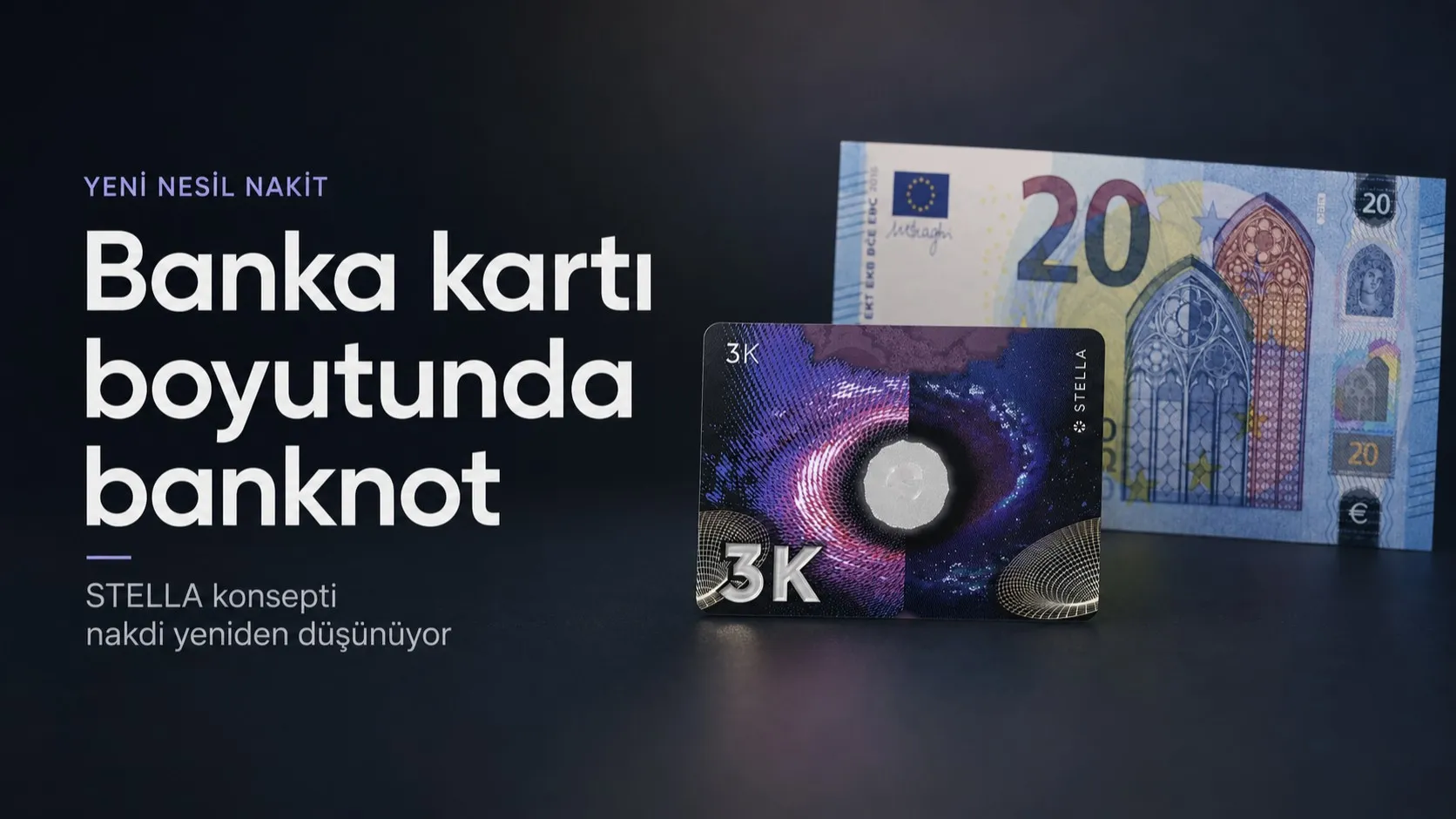
Germany's federal printing office, Bundesdruckerei, unveiled a new banknote prototype called STELLA at the Banknote Conference in Washington. Designed to be the size of a credit card, this experimental banknote shrinks the traditional banknote format, aiming for less material, less ink, and lower energy consumption.
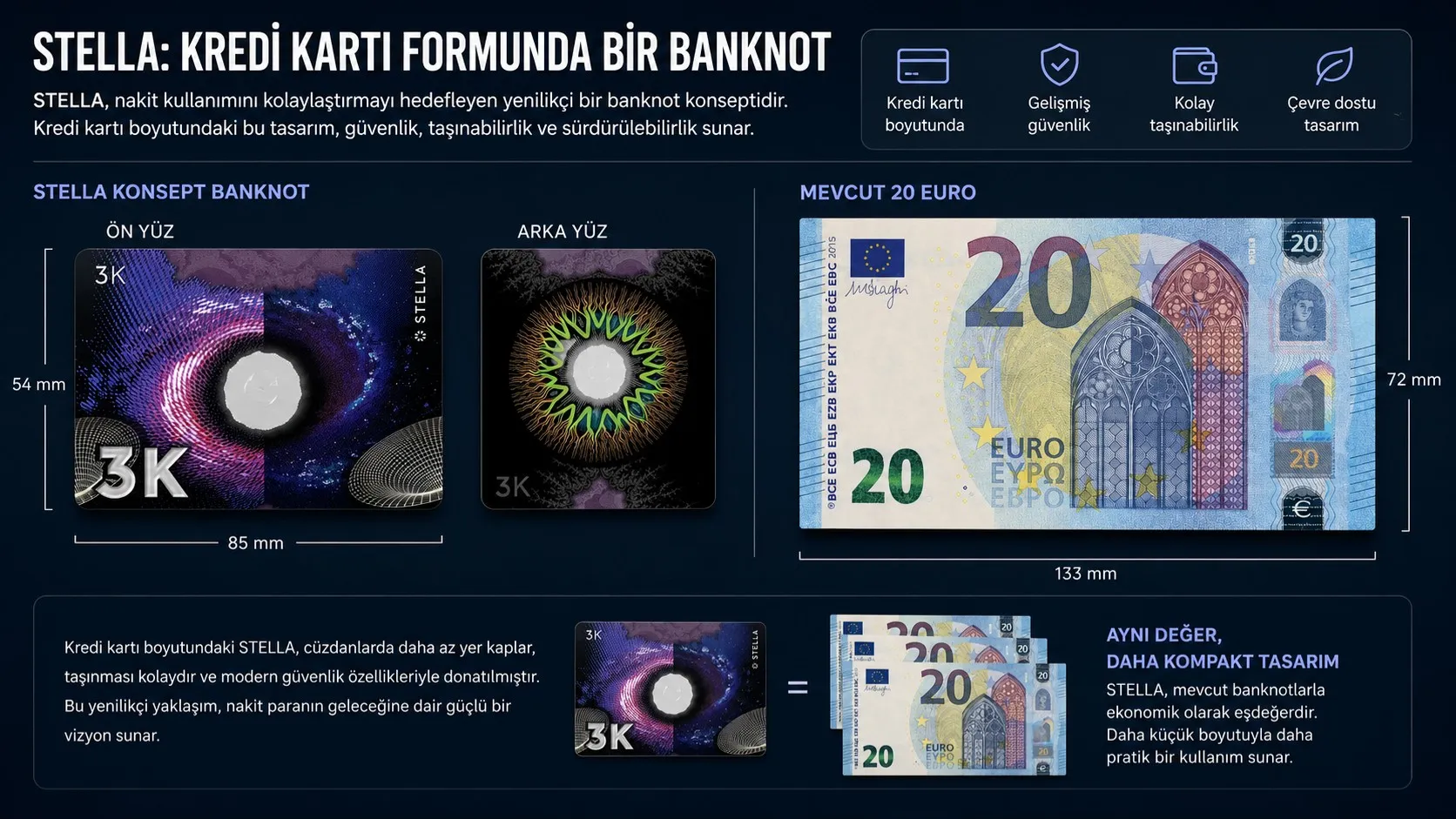
Measuring 85 x 54 mm, STELLA is significantly smaller than the 133 x 72 mm of a 20-euro note. The prototype, a new addition to Bundesdruckerei's experimental Ex Nihilo series, follows the world's first black banknote, IGNIS, introduced in 2024.
STELLA's starting point is the idea that cash can still have a new physical language in an increasingly digital world.
Smaller banknote, less resource use
STELLA stands out not only for its unusual size but also for its sustainability approach. A smaller surface area means less ink, less energy, and shorter processing times in production.
The prototype's name supports this idea. STELLA, Latin for "star," draws on the concept that carbon is found both in the human body and in banknotes. The design combines this cosmic reference with reduced resource usage.
The banknote is designed on a polymer surface derived from renewable, non-fossil sources. Thus, the project moves sustainability beyond a mere visual theme, embedding it directly into the production method.
This approach sets STELLA apart from a classic banknote design experiment. The prototype's core claim is not just to change the appearance of money, but to rethink its production logic.
Small format, new security design challenges
Shrinking a banknote's size brings a significant design problem: the security area shrinks too.
Traditional banknotes require a large surface for holograms, special printing, security threads, and micro-details. With STELLA, this space is drastically reduced, so security features are spread across the entire surface of the note.
To use this limited space more efficiently, Bundesdruckerei adopted a design approach that runs from edge to edge. Some security features are split into two parts, designed to only show their full effect when brought together.
In developing the prototype, Bundesdruckerei worked with security printing experts Koenig & Bauer, SICPA, and KURZ. Thus, STELLA is not just a small banknote object; it also becomes an experimental study in security design.
STELLA is not currency for circulation, but a design lab
STELLA is not expected to enter circulation anytime soon. The project is positioned as a design prototype developed to think about the future of cash, rather than directly changing the current monetary system.
In this sense, STELLA offers a proposal for how cash might be renewed in an era of rapidly spreading digital payment habits. As card, mobile, and contactless payment systems become central to daily life, the physical existence of the banknote faces new questions.
One of these questions is quite simple: Why does a banknote still have to be the size we know?
STELLA doesn't give a definitive answer to this question. Instead, it shows that banknote design is still an area open to experimentation.
The new design language of cash
Banknote design has long been shaped around trust, state symbols, historical figures, and security features. However, in recent years, some countries and institutions have begun to treat this field as a more contemporary design issue.
Norway's pixelized coastline designs by Snøhetta showed that banknotes are not just payment tools, but also everyday design objects carrying national identity. STELLA continues this discussion from a different angle: focusing less on visual identity and more on format, resource use, and production logic.
Bundesdruckerei's prototype raises the possibility of a future where cash doesn't completely disappear, but becomes more efficient and more compact.
STELLA may not enter wallets today. But this credit card-sized banknote opens up the discussion about the future of money not only on digital screens, but also through objects still held in hand.