You hire a football legend for an ad, and most of the time, all you get is a "famous face."
You put the jersey on them. You have them look at the camera. You feed them a bite. Then you wrap the campaign in sentences that have been breathing the same air for years: "legendary taste," "match-day fun," "we're passionately committed." It happens. It goes live. Nobody fights. Nobody thinks twice.
That's not what's going on with KFC México's Roberto Carlos work.
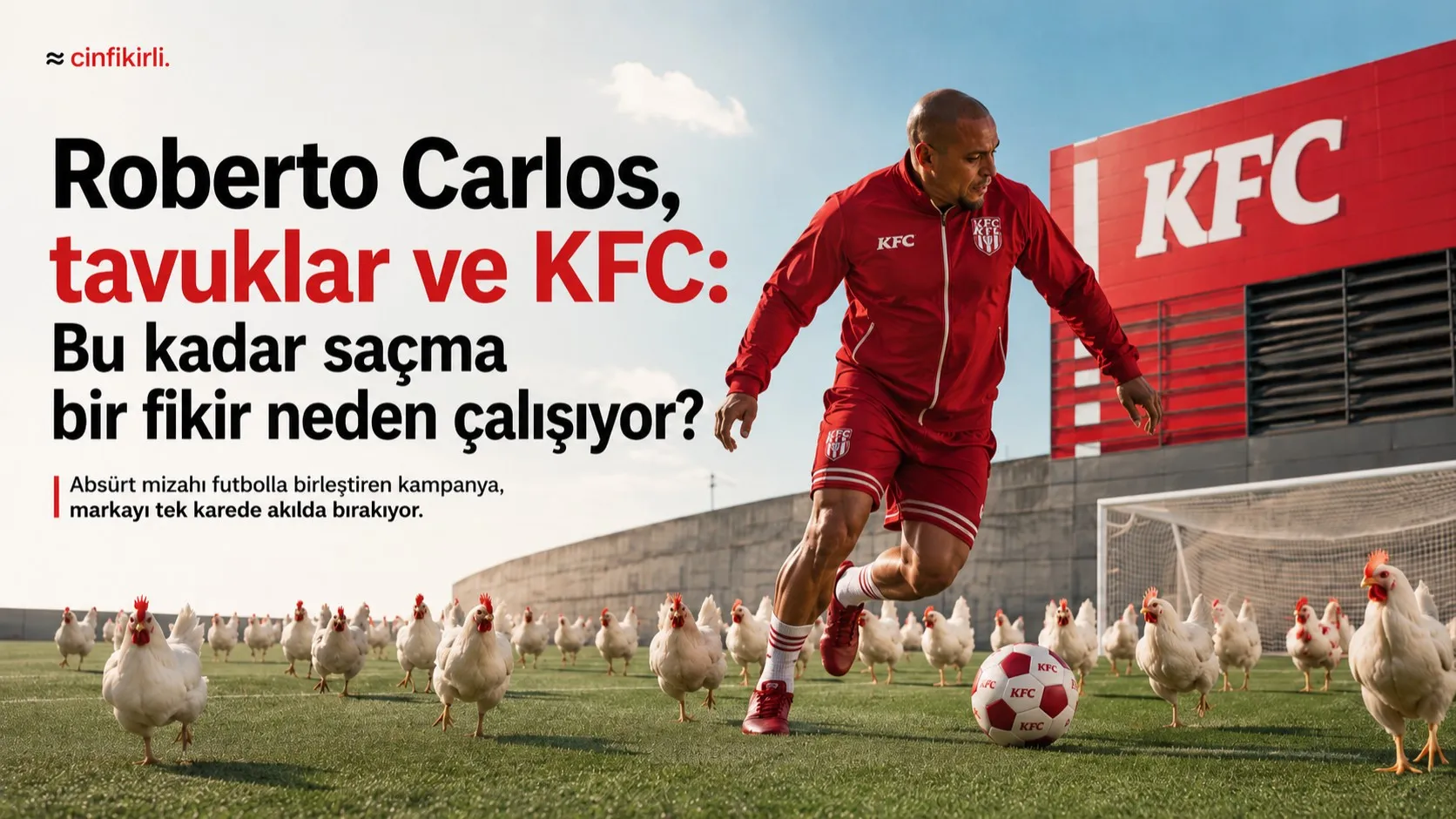
Here, the brand isn't just putting an ex-footballer in the window. It's bringing together Roberto Carlos's strongest physical association in football memory—his legs—with one of KFC's most familiar products, using the same word. In Spanish, the word for chicken leg, "pierna," lives in the same universe as the human leg. LePub Mexico City ran with this, positioning Roberto Carlos as the "coach" of KFC chicken drumsticks. The campaign leans into the rising buzz of football season; but instead of acting like an official sponsor, it slides in from the edge of the football conversation.
I think what needs to be discussed here isn't "Roberto Carlos starred in an ad."
The real point is this: KFC didn't just stick a celebrity onto the product; they collided the celebrity's cultural meaning with the product's physical meaning in the same word.
That's how you use a celebrity well.
Using a celebrity is easy, using their meaning is hard
Most brands think celebrity work is this: Find someone recognizable, put the product in their hand, have them look at the camera, burn the budget.
Why?
Because they think recognition transfers. "If they're famous, the brand gets attention." Simple math. Sometimes it works. But that's not an idea; it's rented attention.
And rented attention is expensive. Plus, when the lease is up, you're out of the house.
KFC's move with Roberto Carlos sits somewhere else. Roberto Carlos wasn't chosen just because he's a footballer. Not just because he's Brazilian. Not just because he's a World Cup memory. What made him the choice is that, throughout his career, his leg strength turned him into almost a visual brand.
That famous free kick he scored against France in 1997 still circulates as one of those images that challenges the laws of physics in football. The Real Madrid years, the Brazil jersey, the playing style that turned the left-back position into an attacking weapon—Roberto Carlos's name isn't just a footballer's name; it's become a package of associations: "leg," "power," "hard shot," "impossible curve."
And that's exactly where KFC is looking.
No, it's not "eat chicken while watching the game."
No, it's not "KFC is perfect for football fun."
No, it's definitely not "a legendary footballer chose a legendary taste."
The right sentence is this: One of football's most famous legs is training KFC's legs.
Let's call this "meaningful casting."
Meaningful casting uses not the celebrity's fame, but their place in memory. If the idea feels half-missing without that person in the ad, the casting is right. If the idea collapses when you swap them out, it's even more right.
Put any other ex-footballer in Roberto Carlos's place. The work fades instantly.
Because the joke is in the leg. The product is in the leg. The football memory is in the leg. That's the knot KFC found.
This starts with a wordplay but doesn't stay there
Wordplays are dangerous.
One side works fast. People catch it instantly. They smile. They say, "Okay, I get it." But if there's nothing else there in the second second, the work immediately feels thin. Some ideas that get loved in agency presentations but fizzle out in the real world die this way.
What makes the difference here is that the wordplay is tied to a cultural moment.
KFC México places the campaign in football season. The source material makes this side clear: The brand, in a period when conversation is already turning to football, bends the topic of "best legs" toward its own product. Roberto Carlos becomes a coach figure who is "validating, training, supervising" the chicken drumsticks. So the idea isn't just a pun sitting on a poster; it builds a small universe.
There's training.
There's approval.
There's coaching.
There's the claim of "best legs."
Once this universe is built, the joke doesn't end in a single sentence. It becomes extendable across visuals, video, social media, and product language.
That's how a good wordplay behaves. It doesn't just become a headline. It becomes a mechanism.
When Liquid Death connected "water" to death metal aesthetics, they didn't just design a can; they built the language, the merch, the social media, the brand attitude from the same place. When Snickers said "you're not you when you're hungry," they didn't just make one commercial; they found a behavioral space that could open up to different characters. When Old Spice sold men's grooming products, they moved from deodorant benefits to an absurd masculinity parody. KFC México's Roberto Carlos work is certainly not a brand platform on that scale; but it uses the same principle in a small, clear activation.
What makes an idea big is often not the budget.
It's whether the idea can withstand rubbing against other surfaces.
Entering the football conversation without being a sponsor
The most expensive reflex in sports marketing is clear: become a sponsor.
Sponsor the tournament. Sponsor the team. Get on the jersey chest. Get on the broadcast band. Buy a board in the stadium. Purchase the official rights. Then say, "we're with football."
Okay. Sometimes it's necessary. For big brands, it's part of the visibility game.
But not every brand can sit at that table. And even if they do, there's no guarantee they'll have an idea at that table. Being an official sponsor doesn't mean being talked about culturally. Sometimes, your logo just sits in a more expensive place.
KFC chooses another path here: they don't buy the conversation; they find the open door within it.
That's why the campaign is more interesting as a brand activation. The brand doesn't puff itself up as "football's official partner." It matches Roberto Carlos's leg memory with KFC's chicken leg product and slips into the agenda of the football season through a side door. The Miller Lite example Creapills gives in the same article leans on a similar logic: The brand, without being an official sponsor around the World Cup, turns a football into a 12-can beer cooler. That is, it takes the symbol of the game and bends it into a fan ritual.
Sound familiar?
"Let's become an official sponsor."
"Let's do a jersey collaboration."
"Let's be seen in the stadium."
"Let's send an influencer on match day."
"Let's do a ball-juggling challenge."
None of these are ideas on their own. They can be distribution or activation pieces. An idea is something else.
An idea is the sentence with which a brand enters culture.
KFC's sentence is simple: In football, everyone talks about the best legs; our best legs are already on the menu.
Cheesy? There's a fine line. With the wrong casting, it would be cheesy. With the wrong tone, it would be vulgar. If they oversold the product, it would turn into a cheap sketch. But the choice of Roberto Carlos carries this joke. Because the man's place in memory is already half the joke.
Would it work in Turkey?
On the Turkish side, this work has an interesting extra layer: Roberto Carlos is remembered here not just as a foreign football legend, but as a name who wore the Fenerbahçe jersey. He played for Fenerbahçe between 2007 and 2009, so in Turkey, the name Roberto Carlos isn't just Real Madrid or Brazil nostalgia; it also touches the memory of Kadıköy.
That's the good news.
The bad news is: If this exact idea were done in Turkey, it would probably be sterilized in the first meeting.
Would the word "leg" seem too crude?
Would saying "chicken leg" lower the premium perception?
Should we show Roberto Carlos more respectfully?
Should we tone down the joke a bit?
Should we be careful about football sensitivities?
Would other fans be offended because of his Fenerbahçe past?
All of it would be discussed. Some might even be right. In Turkey, football is both a goldmine and a minefield for brands. Everyone wants to get into football; but no one wants to fully take on the fan's anger, club loyalty, mocking language, or social media lynching.
So most work retreats to safe ground.
"Match excitement is here."
"Flavorful minutes."
"With the team."
"Match fun with friends."
These sentences don't hurt anyone. And that's the problem. Most sentences that don't hurt anyone also don't help anyone.
Would KFC's Roberto Carlos idea live in Turkey?
It would. But with two conditions.
One: The brand would have to decide from the start how far the joke would go. There's no such thing as a half-joke. When a joke is left half-finished, you end up more embarrassed.
Two: The celebrity would have to be chosen not just because they're familiar, but because they carry the meaning at the center of the word. That's why Roberto Carlos is right. When you say "leg," he has a place in the mind. When you say "shot," he has a place. He has an image in football memory. His name isn't empty in Turkish memory either.
If this work were to be done with a local celebrity, the question isn't "who's popular?" It's "who can connect to this product with the same word, the same gesture, the same memory?"
My job is to love that question.
Because a bad ad starts with "who do we have?" A good idea starts with "which memory can we use?"
Sometimes the shortest line between product and culture is a single word
What KFC did might not look like a big strategy lesson. A fast-food brand took an ex-footballer and made a leg joke with a chicken drumstick. From the outside, that's it.
But some of the best moments in advertising work exactly like this. They don't make big statements. They catch a word in the right place.
Here, the word is "leg."
It's in the product.
It's in football.
It's in Roberto Carlos.
It's in the conversation of the football season.
When four pieces come together at the same point, the campaign doesn't need much explanation.
The question for your brand is the same. What word in your product opens up to culture? What gesture? What obsession? What human memory, when collided with, makes the product instantly more talked about?
No, this doesn't always mean using a celebrity.
Sometimes an object is enough. Sometimes a ritual. Sometimes a local habit. Sometimes a tension everyone makes fun of but the brand can own.
But first, you have to find it. Otherwise, all you're left with is an expensive face, a red logo, and a forgettable post shared on match day.
KFC found the leg here.
The ball is now in your court: What's the word in your product that opens up to culture?